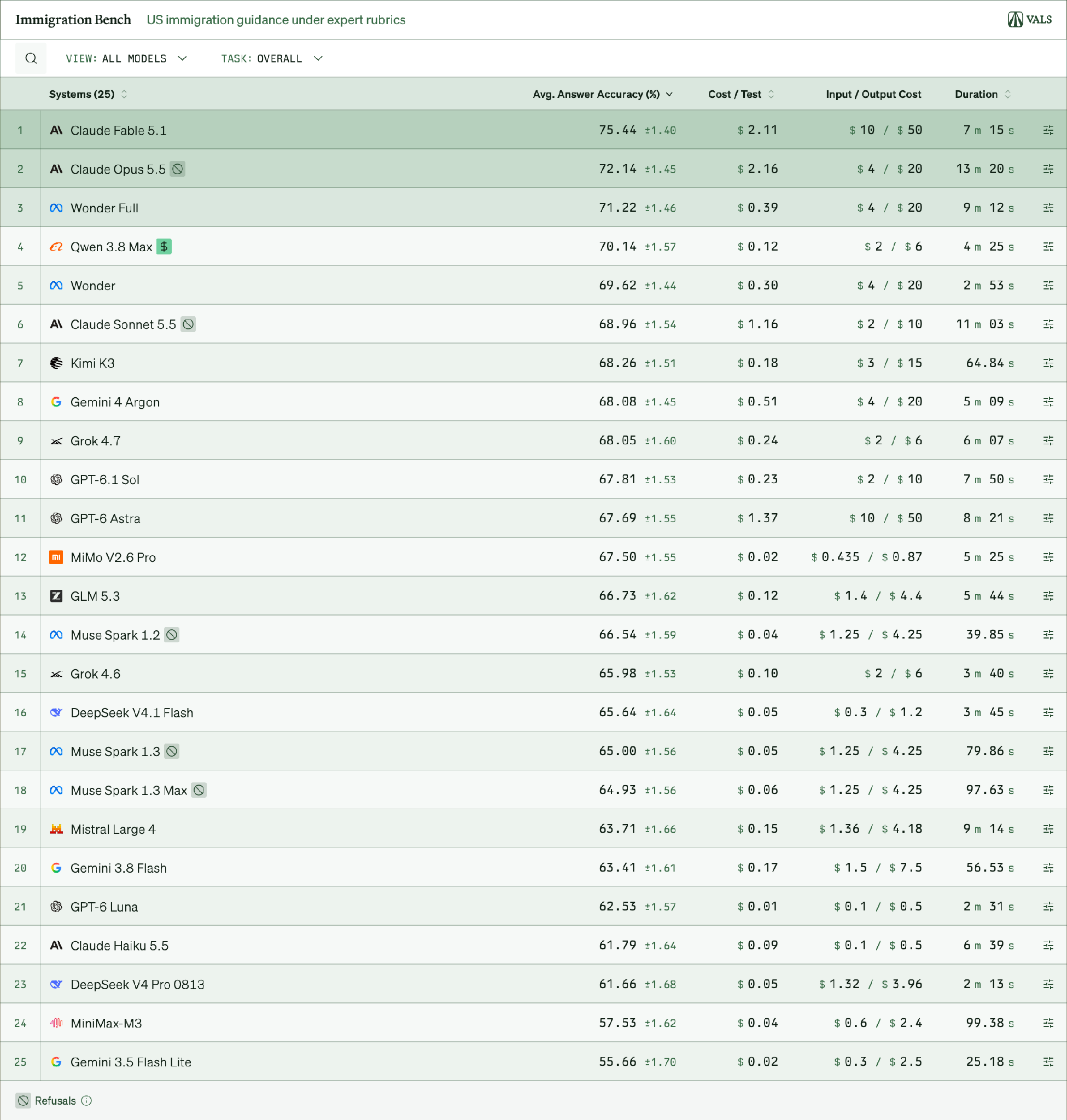
Live results are on the Immigration Bench page.
Key Takeaways
- No AI model performs well enough to be trusted with immigration guidance. The top-performing model, Claude Fable 5.1, met 75.4% of each question’s rubric items on average, and gave a fully correct answer (defined as meeting every item on the rubric) on only 26.3% of questions. For the most vulnerable users, including those with Deferred Action for Childhood Arrivals (DACA) or Temporary Protected Status (TPS), even the best model met only 63.9% of rubric items on average.
- Models explain the law better than they apply it. Immigration advice depends on the specific person’s facts. Every model was better at explaining general rules than at working out what those rules mean for the person asking. Models that asked the person more questions did not score higher overall: asking questions earned credit on fact-finding items but did not improve the legal guidance itself.
- No single model has the full picture. Together, the 25 models met about 93% of what the experts asked for — but the best individual model met only 75.4%, meaning a significant share of what the benchmark requires sits outside any one model’s reach. Recent policy is the starkest exception: on rules from 2025 and 2026, even all 25 models combined met only about 29% of rubric items. The knowledge gap on recent immigration law is not a model-selection problem — it is a structural one.
- Recent policy changes are an invisible gap. Models met only 7.3% of rubric items involving policy rules from 2025 and 2026, compared to 64.0% for established law. Web search helps, but does not reliably close this gap: even the best model with web search met only 43.1% of recent-rule items.
- Employer questions gain the most from web search. Web search raised the average score on Employer questions by 10.4 points, well ahead of its effect on any other persona (6.0 points for University Advisor questions, the next largest). For example, without search, no model knew about a March 2026 change in how ICE enforces I-9 violations.
- Fixing the gaps requires more than better models. The knowledge AI needs to reliably answer immigration questions, such as agency policy memos and adjudication trends, is fragmented across the Department of Homeland Security, the Department of State, immigration courts, and legal practice. Closing the gap will require AI developers to collaborate with immigration attorneys, legal service organizations, and federal government experts to build narrowly scoped, retrieval-grounded tools rigorously tested against real immigration questions.
- Models perform far better on student work permits than on long-term visas for STEM workers. Rubric items on student work authorization (OPT and STEM OPT) were met 76% of the time. Items on the employment-based green card and talent pathways that scientists and engineers use to stay long-term, such as the National Interest Waiver, PERM labor certification, O-1, and EB-5, were met 57% to 60% of the time.
Partners in Evaluation

Immigration Bench is a joint effort by the Talent Mobility Fund, a program of Renaissance Philanthropy, and Vals AI.
Background
About half of U.S. adults now use AI chatbots, according to the Pew Research Center. Immigration questions – about visa eligibility, filing deadlines, work authorization, and what to do when a status is at risk – are among the most consequential. This benchmark tests whether AI gets these answers right.
The consequences of a wrong answer are serious: a missed deadline can mean losing work authorization, incorrect advice about immigration status can trigger removal proceedings, and misinformation about a visa category can cost an employer a key hire.
Vals AI and the Talent Mobility Fund partnered to build an expert-validated benchmark for AI performance on U.S. immigration law. We tested 25 leading AI models against hundreds of questions written by immigration experts. This work is intended as a guide to improvement for AI labs, and to give the public, practitioners, and policymakers a clear, evidence-based picture of where AI stands on U.S. immigration knowledge.
Note: This benchmark focuses on common immigration pathways used by scientists, engineers, and other professionals, such as student visas, work visas, and those transitioning from an uncertain situation, such as Deferred Action for Childhood Arrivals (DACA), to a more durable immigration status. There are many other immigration domains that are out of scope for this study, such as the asylum system and the immigration court system, where the consequences of incorrect information could be even more consequential.
About the Benchmark
Every question has an expert-written rubric: a list of items a complete answer must include. A rubric item counts as met when the model’s answers include it anywhere in the conversation, as judged by an AI grader (see Methodology). A model’s average answer accuracy is the share of each question’s rubric items it met, averaged over all questions.
Immigration experts drafted a benchmark of 519 questions designed to reflect the complexity and stakes of real immigration questions; not textbook scenarios, but the kinds of issues that actually appear on an attorney’s desk or in an immigrant’s search bar. Each question was written from the perspective of a specific persona, such as an international student, an employer, a DACA recipient, or a university advisor, reflecting the range of individuals who actually turn to AI for immigration support. Questions were designed around ambiguous facts, multi-step legal analysis, and situations where the wrong answer carries serious consequences. The goal was not to catch models out on technicalities, but to test whether the models can handle the kind of complexity that people actually encounter.
This page reports results on the 262-question test set, which is kept private to allow ongoing, tamper-resistant evaluation. The other 257 questions are not part of these results and are reserved for the labs to license for their own benchmarking and evaluation work.
- International StudentF-1 visa holders navigating work authorization and maintenance of immigration status64Questions
- International Scholar / FacultyResearchers and academics on J-1 or H-1B visas33Questions
- University AdvisorUniversity staff advising international students33Questions
- EmployerHR professionals and counsel for companies sponsoring noncitizen employees34Questions
- EntrepreneurFounders and business owners navigating their own immigration options34Questions
- Self-PetitionerIndividuals pursuing O-1, EB-1, or similar pathways that are independent of an employer34Questions
- Fragile / Temporary StatusIndividuals on DACA, Temporary Protected Status (TPS), or with uncertain immigration status30Questions
- 7Personas262Test questions
To give a sense of what the benchmark looks like in practice, the table below demonstrates one representative question from each persona.
| Persona | Question |
|---|---|
| International Student | I got an email saying my SEVIS record was terminated. Do I have to leave the U.S. immediately? |
| International Scholar / Faculty | I am a J-1 research scholar. Can I technically obtain an EB-1 while I am on J-1? |
| University Advisor | Can a student with TPS and a pending F-1 change of status still attend full-time until approved? Should they? |
| Employer | Our company just changed its legal name and tax ID. Do I have to re-file immigration paperwork for every single visa holder we employ? |
| Entrepreneur | I would like to apply for an E-2 treaty investor visa upon purchasing partial shares of a restaurant. Is that possible and what counts as a “substantial” investment? |
| Self-Petitioner | Are publications mandatory for a National Interest Waiver or only helpful for academic/research profiles? |
| Fragile / Temporary Status | If I am in the United States under a current TPS designation, can I continue to work with an expired EAD while my EAD extension application is pending? |
Results
Overall performance
The top-scoring model, Claude Fable 5.1, met an average of 75.4% of each question’s rubric items. This means that even the best AI model left out roughly one in four pieces of information an immigration expert would consider essential to a complete answer. Fully correct answers, where a model met every rubric item, were rare: the best rate was 26.3% (Claude Fable 5.1), and rates ranged from 12.6% to 26.3%.
Claude Fable 5.1 leads at 75.4%, 3.3 points ahead of Claude Opus 5.5 (72.1%), a clear lead: on the same questions it scores 1.2 to 5.4 points higher (95% interval). Behind it, 10 models scored within 4.4 points of each other (67.7% to 72.1%).
Without web search, Claude Fable 5.1 had the top score on all seven personas, from 60.9% on University Advisor questions to 90.2% on International Student questions. It did not lead on every single question, though: on 134 out of the 262 questions, at least one other model scored higher.
The models know more together than any one of them shows. A complete answer that drew on the best response to each rubric item across all 25 models would score about 92%, against 75.4% for Claude Fable 5.1, and would be fully correct on about 62% of questions, against 26.3% for Claude Fable 5.1. Even if you could always pick the best model’s answer to each question — knowing in advance which model would do best — you would only score 87%. About 90% of rubric items were met by at least one model — the remaining 10% were beyond every model tested. The gap is less about missing knowledge than about applying it reliably to each specific question: most of what the best model misses, some other model gets right. Recent policy is the exception: even taken together, the models met only about 29% of rubric items on 2025 and 2026 rules.
The combined model score is lowest for Fragile/Temporary Status (84%) and University Advisor (85%) questions, against 93% to 97% for the other personas — a sign that these two personas are more challenging, not just for one model but for all of them. The best single model on each was 63.9% (Fragile/Temporary Status) and 60.9% (University Advisor). These combined figures are best read as an upper bound: because an item counts as met if any one of the 25 models met it, they also include cases where the grader incorrectly marked an item as met.
Significant challenges
Performance varied significantly across personas, from 85.6% average answer accuracy for International Students down to 48.5% for University Advisors. International Students, whose questions tend to be more standardized, such as questions related to Optional Practical Training (OPT) timelines, Curricular Practical Training (CPT) authorization, and maintaining status, received the most reliable answers. University Advisors scored lowest; their questions carry the longest rubrics in the benchmark with 19.5 items on average. Individuals with Fragile or Temporary Status scored second-lowest, at 51.1% average answer accuracy, and for these users the cost of a wrong answer is potentially the most severe. For every model, these two personas were consistently the two lowest.
| Persona | Rubric items per question | Average score (all models, without web search) | Best single model (without web search) | Worst single model (without web search) |
|---|---|---|---|---|
| International Student | 8.6 | 85.6% | 90.2% (Fable 5.1) | 80.2% (Gemini 3.5 Flash Lite) |
| International Scholar / Faculty | 15.7 | 66.7% | 74.8% (Fable 5.1) | 47.4% (Gemini 3.5 Flash Lite) |
| University Advisor | 19.5 | 48.5% | 60.9% (Fable 5.1) | 34.3% (Gemini 3.5 Flash Lite) |
| Employer | 4.8 | 64.6% | 76.1% (Fable 5.1) | 51.7% (MiniMax-M3) |
| Entrepreneur | 4.9 | 64.2% | 72.9% (Fable 5.1) | 52.4% (MiniMax-M3) |
| Self-Petitioner | 4.4 | 63.6% | 74.5% (Fable 5.1) | 52.4% (MiniMax-M3) |
| Fragile / Temporary Status | 9.3 | 51.1% | 63.9% (Fable 5.1) | 38.9% (Gemini 3.5 Flash Lite) |
The people in the most vulnerable immigration situations, likely with the least access to legal counsel, get the weakest answers
For individuals with fragile or temporary status, including DACA recipients and those on TPS, even the best model scored only 63.9% average answer accuracy. Some of the lowest-cost models tested scored as low as 38.9% for this persona.
For example, when asked how soon to renew DACA, Claude Opus 5.5 met every rubric item, while Gemini 3.5 Flash Lite and GPT-6 Luna scored 40% and 20% respectively; they gave the government-recommended renewal window, but neither checked whether the individual was still eligible to renew or flagged the pending Texas v. United States litigation. Every model scored lower on Fragile/Temporary Status than on any other persona except University Advisor. The three lowest scores on the Fragile/Temporary Status persona all came from low-cost models: Gemini 3.5 Flash Lite (38.9%), MiniMax-M3 (42.9%) and DeepSeek V4 Pro (43.1%). Cost does not always determine quality, though: MiMo V2.6 Pro, at under 2 cents a question, scored 56.6%, fourth-best of the 25 models.
AI knows the rules better than it knows how to apply them
The questions that the models found most challenging share a common thread: they turn on recent policy changes, operational details, or the individual’s specific circumstances. Whether premium processing has become the default for National Interest Waiver (NIW) petitions (16% average score across models) or whether an NIW can cover work in multiple roles or industries (33% average score across models, see Example 4) both require either up-to-date policy knowledge or multi-step reasoning applied to a specific situation. At the other end, 4 questions were answered fully correctly by every model, and others came close, such as whether a student whose F-1 visa has expired is “undocumented,” where 24 of 25 models met every item (see Example 5). All of them turn on well-established, foundational legal distinctions that have not changed recently.
This pattern holds at the rubric item level too. Rubric items requiring the model to confirm something about the person’s circumstances — their visa stage, their eligibility, their filing history — were met only 43% of the time, compared to 63% for items asking AI to explain the law or recommend a next step, and 86% for items warning it away from a specific mistake. AI is better suited as a research and explanation tool than as a diagnostic one. It can tell you what the law says — but it struggles to tell you what the law means for you. Asking the user more questions was not the fix: when a model asked questions in its first reply, it met about 4 points more of the fact-finding items on that question, but its overall score barely moved (under 1 point) and its legal guidance did not improve.
| Models | International Student | International Scholar / Faculty | Employer | Entrepreneur | Self-Petitioner | Fragile / Temporary Status | University Advisor |
|---|---|---|---|---|---|---|---|
| Field mean | 85.6 | 66.7 | 64.6 | 64.2 | 63.6 | 51.1 | 48.5 |
 Claude Fable 5.1 | 90.2+4.6 | 74.8+8.1 | 76.1+11.5 | 72.9+8.7 | 74.5+11.0 | 63.9+12.8 | 60.9+12.4 |
| Claude Opus 5.5 | 88.9+3.3 | 74.6+7.9 | 74.5+10.0 | 68.0+3.8 | 65.2+1.7 | 59.8+8.7 | 57.2+8.7 |
 Wonder Full | 88.2+2.7 | 73.4+6.7 | 74.9+10.4 | 68.9+4.7 | 66.9+3.3 | 55.3+4.2 | 53.6+5.1 |
 Qwen 3.8 Max | 86.7+1.1 | 71.8+5.1 | 64.9+0.3 | 71.5+7.2 | 71.2+7.6 | 55.1+4.0 | 53.0+4.5 |
| Wonder | 86.3+0.7 | 72.8+6.1 | 69.0+4.4 | 66.1+1.9 | 70.0+6.4 | 51.7+0.6 | 54.1+5.6 |
| Claude Sonnet 5.5 | 86.5+1.0 | 65.6-1.2 | 70.9+6.3 | 69.6+5.4 | 63.60.0 | 57.7+6.6 | 51.3+2.8 |
 Kimi K3 | 85.2-0.4 | 71.3+4.6 | 72.8+8.2 | 64.3+0.1 | 66.4+2.8 | 51.4+0.3 | 49.0+0.5 |
 Gemini 4 Argon | 86.6+1.0 | 67.6+0.9 | 63.9-0.6 | 61.3-2.9 | 71.3+7.7 | 55.5+4.4 | 51.9+3.4 |
 Grok 4.7 | 87.2+1.7 | 71.7+5.0 | 64.0-0.6 | 64.0-0.2 | 65.3+1.7 | 53.3+2.2 | 51.8+3.3 |
 GPT-6.1 Sol | 88.3+2.8 | 70.4+3.6 | 66.0+1.4 | 66.7+2.5 | 63.9+0.3 | 50.1-1.0 | 48.60.0 |
| GPT-6 Astra | 88.6+3.0 | 69.9+3.2 | 68.2+3.7 | 68.6+4.4 | 58.4-5.2 | 49.4-1.7 | 49.6+1.1 |
 MiMo V2.6 Pro | 86.1+0.5 | 68.5+1.8 | 63.6-1.0 | 64.5+0.3 | 65.4+1.8 | 56.6+5.4 | 49.7+1.1 |
 GLM 5.3 | 85.5-0.1 | 66.9+0.2 | 67.4+2.8 | 60.8-3.4 | 67.1+3.5 | 48.3-2.8 | 51.9+3.4 |
| Muse Spark 1.2 | 86.3+0.8 | 66.5-0.3 | 62.5-2.1 | 67.5+3.3 | 65.5+1.9 | 48.9-2.2 | 48.50.0 |
| Grok 4.6 | 84.0-1.5 | 69.4+2.7 | 61.7-2.9 | 63.9-0.3 | 66.2+2.6 | 52.9+1.8 | 45.7-2.8 |
 DeepSeek V4.1 Flash | 86.8+1.2 | 69.0+2.3 | 59.4-5.2 | 62.1-2.2 | 65.0+1.4 | 47.6-3.5 | 48.4-0.2 |
| Muse Spark 1.3 | 83.4-2.2 | 65.5-1.2 | 62.5-2.1 | 64.8+0.6 | 61.8-1.7 | 50.3-0.8 | 48.2-0.3 |
| Muse Spark 1.3 Max | 86.6+1.0 | 63.1-3.7 | 64.2-0.4 | 63.7-0.5 | 58.3-5.3 | 50.6-0.6 | 46.6-2.0 |
 Mistral Large 4 | 82.4-3.2 | 62.9-3.8 | 67.0+2.4 | 65.1+0.9 | 62.2-1.4 | 47.0-4.1 | 40.3-8.2 |
| Gemini 3.8 Flash | 84.3-1.3 | 63.2-3.5 | 61.0-3.6 | 60.5-3.8 | 58.4-5.2 | 49.8-1.4 | 46.1-2.4 |
| GPT-6 Luna | 83.8-1.7 | 65.3-1.4 | 55.3-9.3 | 63.4-0.8 | 58.4-5.2 | 43.3-7.9 | 46.7-1.8 |
| Claude Haiku 5.5 | 83.9-1.7 | 58.8-8.0 | 60.8-3.8 | 57.3-6.9 | 57.8-5.8 | 54.5+3.4 | 38.4-10.1 |
| DeepSeek V4 Pro 0813 | 82.2-3.3 | 59.5-7.2 | 55.0-9.6 | 63.7-0.5 | 61.1-2.5 | 43.1-8.0 | 46.2-2.3 |
 MiniMax-M3 | 81.0-4.6 | 58.2-8.5 | 51.7-12.8 | 52.4-11.8 | 52.4-11.2 | 42.9-8.2 | 41.2-7.3 |
| Gemini 3.5 Flash Lite | 80.2-5.4 | 47.4-19.3 | 57.3-7.3 | 53.8-10.4 | 53.3-10.3 | 38.9-12.2 | 34.3-14.2 |
The heatmap above removes question difficulty: each cell is a model’s score on that persona minus the 25-model mean on the same questions. Every model scores 29 to 46 points lower on University Advisor questions than on International Student questions.
With 30 to 64 questions per persona, the standard error on a persona score is about 2 to 6 points. Thus, these scores should be read as indicative rather than definitive.

AI is flying blind on recent immigration law
Immigration policy has changed significantly in 2025 and 2026, with new rules affecting OPT, H-1B, and other key pathways. 65 rubric items cite a rule from 2025 or 2026. Without web search, pooled across all 25 models, these rubric items were met 7.3% of the time, against 64.0% for every other item. The best model on these items, Claude Fable 5.1, met these rubric items 18.5% of the time. Even with web search, these rubric items were met only 29% of the time.
For example, when an international student asked how the end of “duration of status” affects them, no model distinguished, without web search, between students admitted before and after the July 2026 DHS Duration of Status final rule was scheduled to take effect. With web search, only 3 of 25 did (see Example 1).
The takeaway: users should verify anything touching on recent policy against primary sources such as USCIS.gov, the Federal Register, or current agency guidance, whether or not the tool searches the web.
Claude Fable 5.1Claude Opus 5.5Wonder FullQwen 3.8 MaxWonderGrok 4.7Claude Sonnet 5.5MiMo V2.6 ProGemini 4 ArgonKimi K3GLM 5.3GPT-6.1 SolGPT-6 AstraDeepSeek V4.1 FlashMuse Spark 1.2Grok 4.6Muse Spark 1.3Muse Spark 1.3 MaxGemini 3.8 FlashGPT-6 LunaMistral Large 4DeepSeek V4 Pro 0813Claude Haiku 5.5MiniMax-M3Gemini 3.5 Flash LiteDoes turning on web search help?
We also tested every model with web search enabled, on the exact same questions and with the same simulated person and grader. Web search helped some models substantially: MiniMax-M3 (an increase of 9.1 points), Claude Haiku 5.5 (an increase of 9.0 points) and DeepSeek V4.1 Flash (an increase of 8.3 points). For 7 of the 25 models run with search, it added less than two points, including Claude Fable 5.1 (1.2 points).
Qwen 3.8 MaxClaude Fable 5.1Wonder FullClaude Opus 5.5Claude Sonnet 5.5Grok 4.7DeepSeek V4.1 FlashWonderGLM 5.3MiMo V2.6 ProGrok 4.6Mistral Large 4Claude Haiku 5.5Muse Spark 1.3 MaxMuse Spark 1.3Muse Spark 1.2Gemini 4 ArgonGPT-6.1 SolKimi K3GPT-6 AstraDeepSeek V4 Pro 0813MiniMax-M3Gemini 3.8 FlashGPT-6 LunaGemini 3.5 Flash LiteBy persona, web search helped most on Employer questions, adding 10.4 points on average, adding 6.0 points for University Advisor questions, the next largest, and 1.6 points for International Student questions. Models searched in nearly every conversation (98.9%), but how much they searched did not predict how much they gained: GPT-6 Luna averaged over 100 searches per conversation and gained only 1.8 points, while DeepSeek V4 Pro averaged about 10 searches and gained 6.5 points.
| Models | International Student | International Scholar / Faculty | Employer | Entrepreneur | Self-Petitioner | Fragile / Temporary Status | University Advisor | All questions |
|---|---|---|---|---|---|---|---|---|
| Mean gain | +1.6 | +3.7 | +10.4 | +4.9 | +5.4 | +3.4 | +6.0 | +4.7 |
| Claude Fable 5.1 | -1.0 | 0.0 | +4.8 | +0.1 | +4.1 | +2.4 | -0.1 | +1.2 |
| Claude Opus 5.5 | 0.0 | -2.1 | +2.3 | +9.4 | +5.1 | +3.9 | +4.6 | +3.0 |
| Wonder Full | +1.2 | +1.2 | +8.2 | +4.2 | +10.7 | +5.9 | +7.6 | +5.1 |
| Qwen 3.8 Max | +3.5 | +4.0 | +16.8 | +2.7 | +7.5 | +10.1 | +10.7 | +7.4 |
| Wonder | -0.1 | +0.5 | +12.1 | +5.1 | +7.7 | +5.6 | +2.4 | +4.2 |
| Claude Sonnet 5.5 | +2.0 | +6.7 | +7.7 | +4.5 | +10.3 | +5.2 | +3.9 | +5.3 |
| Kimi K3 | +1.8 | -5.8 | +2.1 | +5.5 | -1.4 | 0.0 | +2.8 | +0.8 |
| Gemini 4 Argon | +0.4 | -1.5 | +10.8 | +6.5 | -1.7 | -0.9 | +1.0 | +1.9 |
| Grok 4.7 | +2.3 | +4.2 | +12.1 | +8.2 | +7.9 | +5.9 | +4.8 | +6.1 |
| GPT-6.1 Sol | -0.5 | -0.4 | +6.4 | -2.6 | +4.2 | -1.2 | +5.3 | +1.4 |
| GPT-6 Astra | -1.9 | +1.4 | +2.6 | -3.8 | +4.4 | +2.1 | +5.9 | +1.1 |
| MiMo V2.6 Pro | +2.1 | +5.5 | +9.7 | +5.5 | +5.7 | -0.6 | +7.6 | +4.8 |
| GLM 5.3 | +2.7 | +4.4 | +12.4 | +15.9 | +4.9 | +6.0 | +6.4 | +7.0 |
| Muse Spark 1.2 | +2.4 | +3.7 | +13.5 | +0.5 | +1.0 | +1.2 | +4.3 | +3.7 |
| Grok 4.6 | +2.1 | +2.6 | +14.1 | +9.7 | +6.3 | +1.0 | +9.9 | +6.1 |
| DeepSeek V4.1 Flash | +0.8 | +5.1 | +21.7 | +9.6 | +8.4 | +7.1 | +11.7 | +8.3 |
| Muse Spark 1.3 | +4.8 | +5.7 | +9.0 | +6.1 | +4.8 | +1.7 | +5.6 | +5.4 |
| Muse Spark 1.3 Max | +1.8 | +12.1 | +11.6 | +0.2 | +5.5 | +5.5 | +8.3 | +5.9 |
| Mistral Large 4 | +4.2 | +9.8 | +10.3 | +6.5 | +1.2 | +7.3 | +18.9 | +7.8 |
| Gemini 3.8 Flash | -1.5 | +3.6 | +2.8 | +2.0 | +4.4 | -1.3 | +3.2 | +1.6 |
| GPT-6 Luna | +1.0 | +0.4 | +10.5 | -4.9 | +5.3 | +1.7 | -0.8 | +1.8 |
| Claude Haiku 5.5 | +4.0 | +10.7 | +15.5 | +9.7 | +14.6 | +1.9 | +10.0 | +9.0 |
| DeepSeek V4 Pro 0813 | +1.8 | +4.4 | +22.1 | +6.5 | -1.0 | +7.7 | +8.7 | +6.5 |
| MiniMax-M3 | +5.2 | +7.4 | +19.8 | +10.9 | +10.1 | +8.0 | +5.2 | +9.1 |
| Gemini 3.5 Flash Lite | +0.4 | +8.9 | +0.1 | +5.1 | +4.4 | -0.3 | +3.1 | +2.8 |
Two examples illustrate the difference with web search. In March 2026, ICE reclassified a failure to check the alternative procedure box when using remote I-9 verification as a substantive violation subject to immediate fines. Asked by an employer in exactly that situation, no model mentioned the March 2026 change without web search, and 9 of 25 met the rubric item with web search.
In August 2026, the Board of Immigration Appeals ruled that travel on advance parole can trigger the 3- and 10-year unlawful presence bars. Asked about the risks of traveling abroad on TPS, no model mentioned the decision without search, and 19 of 25 did with search (see Example 3).
The tradeoff is time. Web search makes conversations significantly longer as models search and retrieve pages before responding. The difference is vast: Claude Opus 5.5 and Claude Sonnet 5.5 took a median of about an hour per conversation with web search (70 minutes and 63 minutes respectively), compared to 13 minutes and 11 minutes without. Qwen 3.8 Max took 40 minutes, Claude Fable 5.1 took 22 minutes, and Grok 4.7 took 12 minutes. At the fast end, Kimi K3 and Gemini 3.5 Flash Lite finished in under two minutes. For a person waiting on an answer, an hour-long conversation may not be practical, regardless of how accurate the answers turn out to be.
Search helped most on recent policy: every model met more of the 2025 and 2026 rubric items with web search, but even the best model reached only 43.1% on those items. The takeaway: web search is not a reliable fix for the knowledge gaps these models have on immigration law.
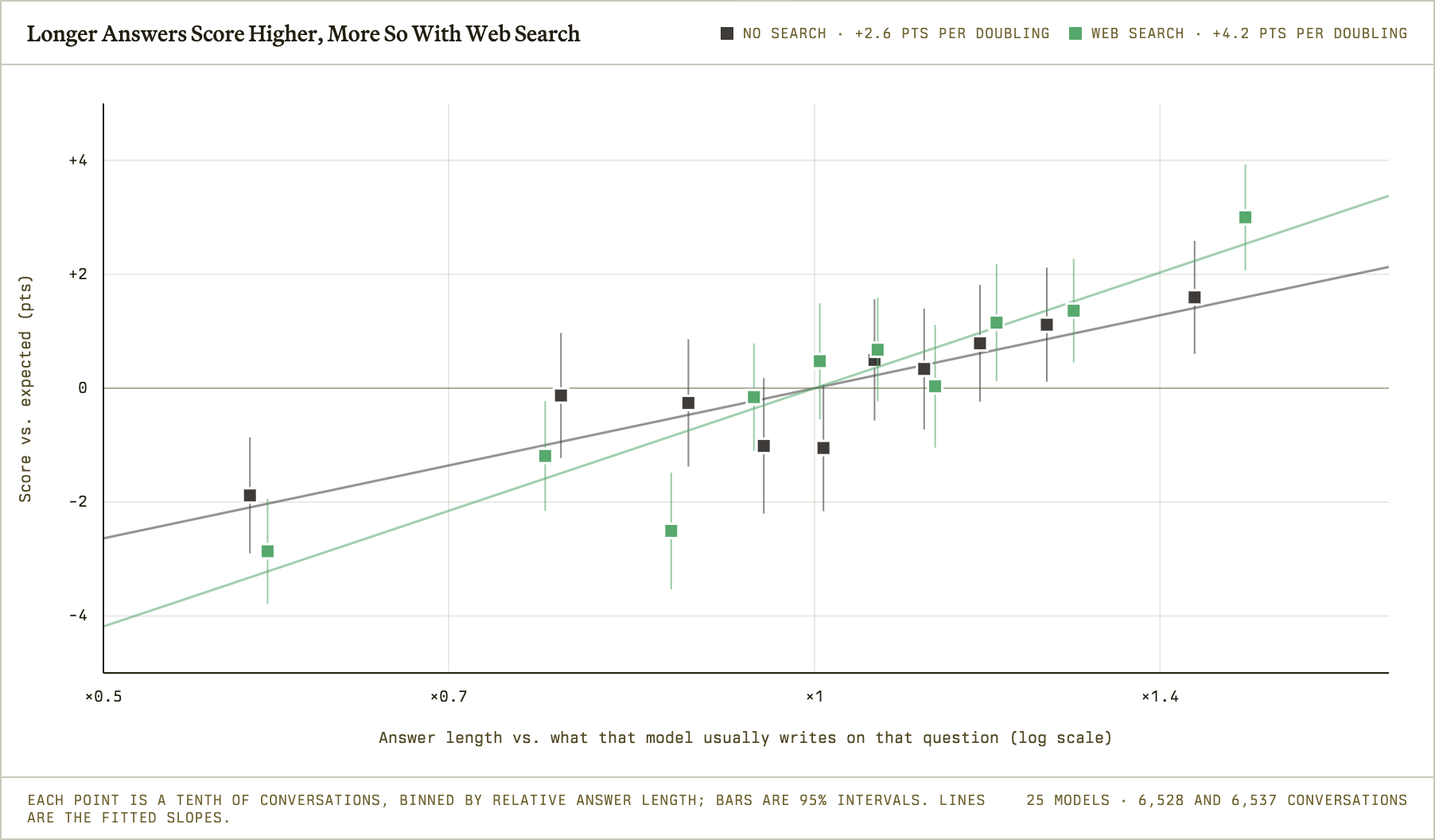
Qwen 3.8 MaxClaude Opus 5.5Claude Haiku 5.5Claude Sonnet 5.5Claude Fable 5.1Mistral Large 4MiMo V2.6 ProDeepSeek V4.1 FlashGLM 5.3Muse Spark 1.3 MaxGemini 4 ArgonKimi K3GPT-6 LunaDeepSeek V4 Pro 0813Grok 4.6WonderMuse Spark 1.3GPT-6 AstraGPT-6.1 SolGrok 4.7Wonder FullMuse Spark 1.2MiniMax-M3Gemini 3.5 Flash LiteGemini 3.8 FlashLonger answers explain part of the web search ranking. The rubric credits every item a model covers, so an answer that says more has more chances to meet items. Comparing each conversation with what the same model usually writes on the same question, an answer twice as long scored about 2.6 points higher without web search and 4.2 points higher with it.
Without search, adjusting for this barely changes the leaderboard: no model moves by more than 2 points, and Claude Fable 5.1 stays first. With search it matters more. As scored, Qwen 3.8 Max leads with search (77.5%), ahead of Claude Fable 5.1 (76.6%) and Wonder Full (76.3%). Qwen’s answers with search run about half again as long as other models’ on the same questions and Fable’s about a third longer, while Wonder Full’s are average length, so after adjusting for length Wonder Full leads: 1.3 points ahead of Qwen and 1.4 ahead of Fable. The most verbose models with search, Qwen 3.8 Max, Mistral Large 4 and MiniMax-M3, lose 2 to 3 points each. Some of that extra length is legitimately covering more of what an expert expects, so this is not a corrected ranking, but differences of a point or two between scores with web search partly reflect how much each model writes.
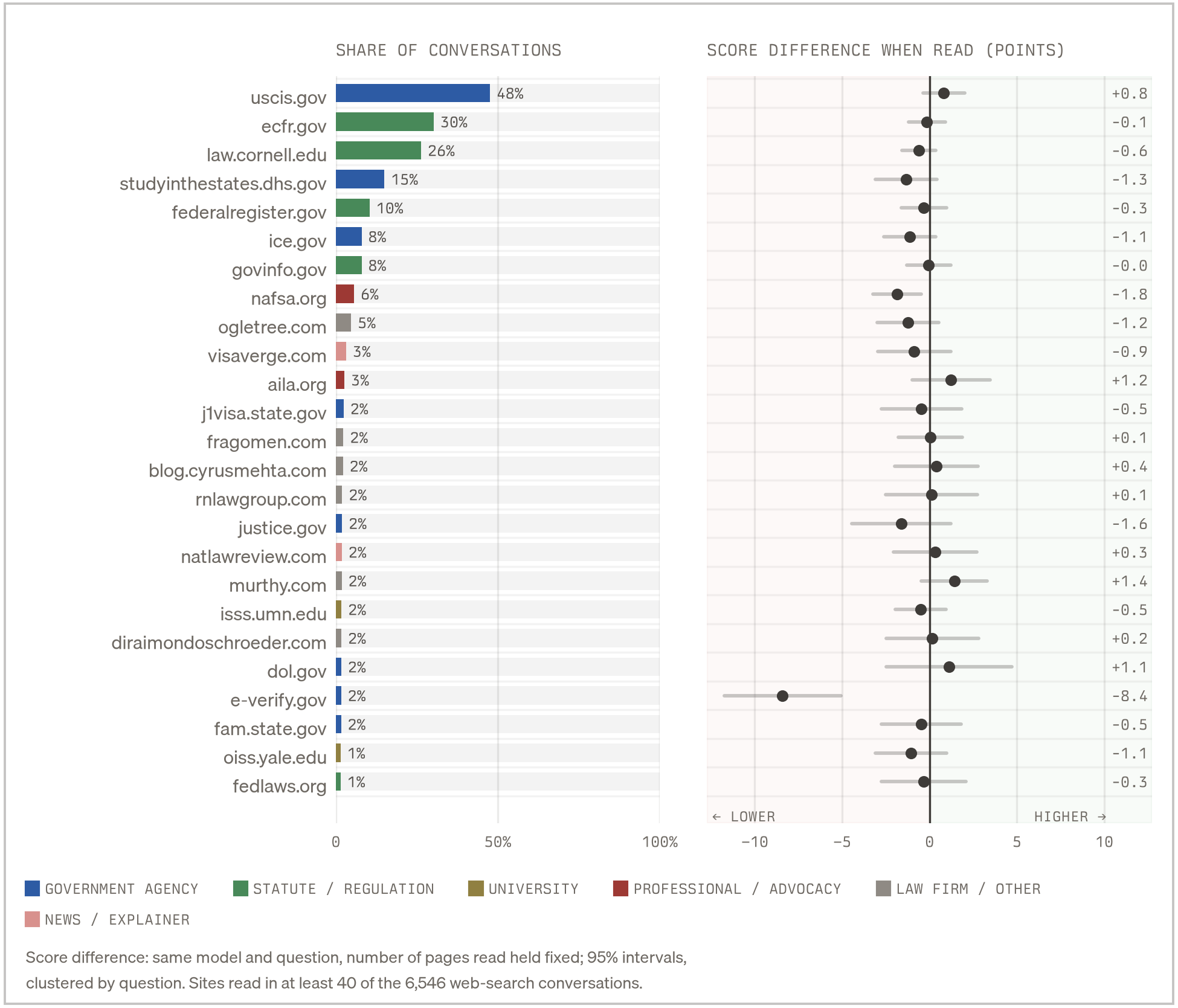
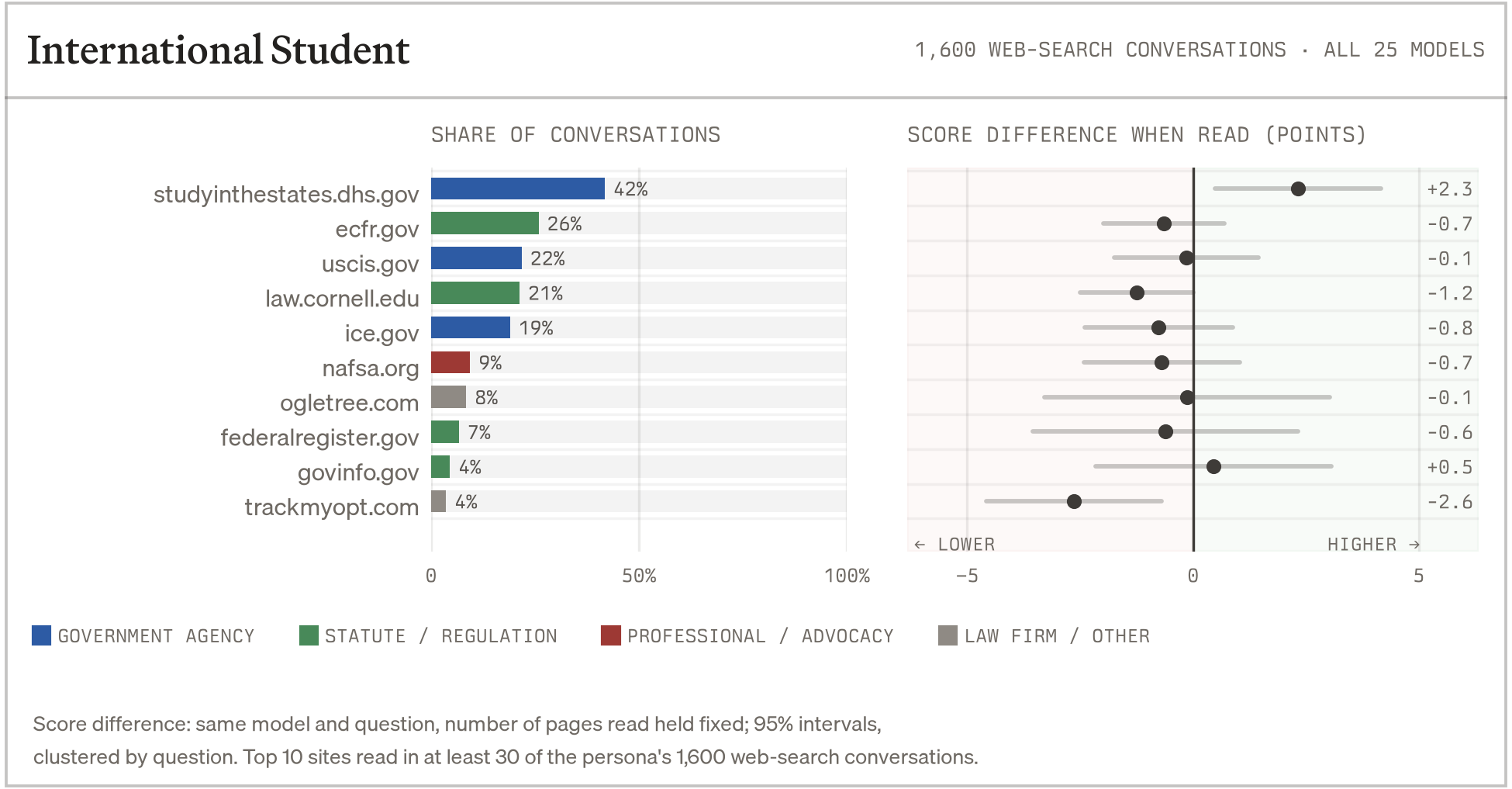
What models looked up. With web search on, models searched autonomously — choosing which websites to visit without any specific direction. Most models read at least one web page, drawn mostly from official sources: government agencies and the regulations themselves made up about two-thirds of what they read. Content from USCIS appeared in nearly half of all conversations. Models gravitated toward different sources depending on the question type — on International Student questions, models most often turned to the Department of Homeland Security’s (DHS) Study in the States website, and on University Advisor questions they most often consulted the regulations directly.
Did it matter which website? Mostly not. No website was associated with reliably higher scores across the benchmark. The only persona-level exceptions were small: answers that drew on DHS’ Study in the States scored about 2 points higher on International Student questions, and answers that drew on the Code of Federal Regulations scored about 4 points higher on Fragile or Temporary Status questions. With this many comparisons, isolated differences should be interpreted cautiously.
The charts below show which websites models read most often and whether reading each site was associated with higher or lower scores — across all questions.
The next chart shows the same breakdown for International Student questions only, where Study in the States was read in 42% of conversations — far more often than any other site (the next, the Code of Federal Regulations, was read in 26%). A full breakdown of sources read by persona is available in the Appendix.
Cost and speed matter too
Cost does not have to mean a large drop in quality for some models.
The top-ranked model, Claude Fable 5.1, costs roughly $2.11 per question. Lower-cost models from U.S. developers come within 7.4 to 8.9 points of it for a fraction of the price: Grok 4.7 and GPT-6.1 Sol score 68.0% and 67.8% for about 24 cents a question, nearly nine times cheaper, and Muse Spark 1.2 scores 66.5% for under 4 cents, more than 50 times cheaper. That makes them practical options for legal aid organizations, nonprofits, and others operating on limited budgets. The steep drop comes at the very cheapest tier: on Fragile/Temporary Status questions, Gemini 3.5 Flash Lite scored 38.9%, against 63.9% for Claude Fable 5.1 — a 26-point gap for the population that can least afford bad advice.
Speed is also a practical concern. Latency, the time to complete a whole conversation of up to five exchanges, is shown in the chart below. Claude Fable 5.1 takes about 7 minutes per conversation, and a person seeking help may give up before they receive a complete answer. Muse Spark 1.2, 8.9 points below the top score, finished in about 40 seconds.
A note on cost and token use. AI models charge per token — roughly per word or word fragment — but the number of tokens each model uses to answer the same question varies enormously. This means the sticker price per token can be misleading: what matters for anyone building an immigration tool is the total cost per question, which is price per token multiplied by tokens used. Output tokens per question, including reasoning, vary more than tenfold, from about 6,800 for Muse Spark 1.2 to about 95,000 for Claude Sonnet 5.5 and Claude Haiku 5.5. Claude Opus 5.5 charges less than half as much per token as Claude Fable 5.1, yet it costs nearly the same per question ($2.16 for Opus 5.5 vs. $2.11 for Fable 5.1), because it uses about two and a half times as many output tokens. Opus also scores 3.3 points lower than Fable. More tokens, it turns out, do not buy a better answer.
The free and low-cost models most people reach first
Most people who ask an AI about immigration will not pay $2 a question; they use free models. About half of U.S. adults now use AI chatbots, and 60% say they read the AI summaries at the top of search results, according to the Pew Research Center. The chatbots they use most are ChatGPT (44% of U.S. adults), Gemini (24%), Copilot (17%) and Meta AI (14%). Worldwide, Google reports that AI Overviews in Search reaches more than 2.5 billion people a month. We could not test these products directly: they add their own instructions and search, and the companies do not disclose which model serves each answer. We did test the low-cost models these companies sell through their APIs.
Their results are a step below the top of the board. Of the nine models from U.S. and European developers that cost under 20 cents a question, the best without web search scored 66.5% (Muse Spark 1.2), 8.9 points behind Claude Fable 5.1, and the weakest scored 55.7% (Gemini 3.5 Flash Lite), last of all 25 models. On questions from people with Fragile or Temporary status, they scored 38.9% to 54.5%, against 63.9% for Fable.
Web search did little for Google’s low-cost models. Gemini 3.5 Flash Lite, the weakest of this group, and Gemini 3.8 Flash scored 55.7% and 63.4% without search and gained only 2.8 and 1.6 points with it. With search, they met just 13.8% and 7.7% of rubric items on 2025 and 2026 rules, the lowest of the 25 models. Meta’s Muse Spark models, which answer in under two minutes, scored 64.9% to 66.5% without search and about 70% with it. With search, the best of the group was Grok 4.6 (72.1%), and Claude Haiku 5.5 gained the most from search (9.0 points).
What This Means for the Immigration Community
- For immigration attorneys: AI can assist with general research and drafting, but should not be relied on to independently advise clients on their specific situation. The gaps in applying the law to a client’s facts are particularly concerning.
- For universities’ international offices: AI performed the worst on the University Advisor persona – questions from school officials advising students – which carry the longest rubrics in the benchmark. Before relying on AI for compliance guidance, Designated School Officials (DSOs) should test it against their most common scenarios and verify its answers against government guidance and the institution’s legal counsel.
- For employers and HR teams: AI performed in the mid-range on Employer questions, and web search helped more on these than on any other persona. It may be useful for general orientation to a visa category, but should not substitute for counsel on specific sponsorship decisions or compliance requirements.
- For legal aid organizations: Of the seven personas, individuals with Fragile or Temporary Status ranked second lowest, just above University Advisors. This benchmark gives concrete evidence of the risks when clients rely on AI for immigration guidance, and a basis for educating them about those risks.
What This Means for AI Labs
This benchmark gives every lab whose model was tested a concrete, evidence-based picture of where it stands. These findings demonstrate the need for progress on at least three fronts:
- Prioritize keeping models current in fast-moving regulatory domains. Immigration law changes constantly, through executive orders, agency policy memos, court decisions, and rulemaking. Models met only 7.3% of rubric items involving rules from 2025 and 2026, and web search only partly closed that gap. Improvements could include more retrieval-augmented tools, real-time policy feeds, and clear disclosures when a model’s knowledge may be out of date.
- Improve how models apply the law to a person’s situation, not just explain it. Knowing the law is not enough; the gap that matters is between explaining a general rule and working out what it means for the specific individual asking. That is where AI falls short most often, and where improvement would have the greatest impact. As in other domains, there is a need for improving how models identify what they need to know about a person’s situation before giving advice, and how they apply general rules to specific circumstances.
- Engage with experts to expand training data access. Much of the knowledge reliable immigration advice depends on is not publicly available in formats AI systems can use. Closing this gap requires proactive collaboration between labs and the immigration legal community on data-sharing arrangements and retrieval-grounded tools.
Methodology
This benchmark was designed to reflect how real people interact with AI on immigration questions, not how researchers in a lab might test a model.
Scoring rubrics
For each question, experts wrote a rubric, which consisted of a checklist of everything a complete and accurate answer must cover: the key legal thresholds, factual elements, recommended next steps, and statements a model should explicitly avoid saying (such as guaranteeing an outcome). All rubrics were cross-reviewed by a second expert before being used. Rubric items were grouped by type into actions a model should confirm about the individual’s situation, points it should explain or recommend, and statements it should avoid — categorized automatically based on each item’s leading verb. Items that only list legal authorities are recorded but not scored.
| Metric | Definition |
|---|---|
| Average Answer Accuracy | Share of each question’s rubric items met, averaged over questions |
| All-Pass | Share of questions where every rubric item was met |
Evaluation pipeline
Rather than asking each model a single question, we simulated a realistic conversation of up to five exchanges. The benchmark uses three models in different roles:
- Tested model: receives the question and tries to help.
- Simulated person: GPT-6 Luna plays the person asking, given the persona’s facts and background, and answers the tested model’s follow-up questions from those facts only. GPT-6 Luna is also one of the tested models — a limitation that is discussed below. It was chosen from three finalists: Claude Haiku 4.5, GPT-6.1 Sol and GPT-6 Luna. When two AI judges checked individual replies against each persona’s facts, Claude Haiku 4.5 invented facts about its own case in 42–48% of replies, against 1–3% for GPT-6.1 Sol and 4–10% for GPT-6 Luna, making Claude Haiku 4.5 unsuitable. Blind comparisons of full conversations, rated by two panels of AI judges and by a member of our team, rated GPT-6.1 Sol more realistic than GPT-6 Luna (the team member rated it 11 to 4, with 3 ties). We chose GPT-6 Luna because it was nearly as faithful to the persona’s facts, did not artificially inflate scores by asking leading questions, and cost about a twentieth as much per conversation.
- Grader: Claude Sonnet 5 evaluates every rubric item as met or not met against the full transcript, with a reason. It was selected through alignment testing with human experts: two immigration experts independently graded the same conversations, and on the rubric items where they agreed, Claude Sonnet 5 matched their verdict 88.6% of the time, the highest of the graders tested.
An item counts as met if the model covers it anywhere in the conversation, not just in its first response. Every model was run twice: once on its own, and once with web search, which could access pages published up to September 21, 2026, the date the question set was finalized. Each conversation had a 30-minute time limit, or three hours with web search; a conversation that exceeded its limit scored zero, and comparisons with and without web search use the questions a model finished in both conditions. Conversations that failed for infrastructure reasons, including grading failures, were re-run. Models were accessed through their providers’ APIs at default settings.
Uncertainty
Average answer accuracy carries a standard error of 1.4 to 1.7 points, so small differences between closely ranked models should be interpreted cautiously. Per-persona scores carry more uncertainty, roughly 2 to 6 points, and should be read as indicative rather than definitive.
Limitations
- The simulated person is an AI model. How it answers and follows up affects what the tested model can draw out. In testing, swapping the simulated person shifted scores by a few points and reordered some closely ranked models.
- The simulated person is also a tested model. GPT-6 Luna plays the simulated person in every conversation and is also one of the 25 tested models, so in its own conversations it is talking to itself, which may affect its score.
- The grader is an AI model. Claude Sonnet 5 agreed most closely with human expert graders, but it is from the same developer as four tested models.
- The rubric measures completeness, not harm. A response is credited for each item it meets. It is not penalized for additional incorrect statements unless the rubric includes an explicit “avoid” criteria. Longer answers also have more chances to meet items; with web search this explains part of the ranking (see “Does turning on web search help?”).
- Some groupings are automatic. Recent-rule items were identified by whether the item cites 2025 or 2026, and item types were grouped by the item’s first word.
- Results are a snapshot. Models, their default settings, and immigration law all change. Each model was run once per condition through its API; consumer-facing products were not tested, and may produce different results by adding their own system instructions or search capabilities.
Example Questions and Scoring
The following nine questions from the test set illustrate how models performed across different scenarios — each shown with an excerpt of the expert rubric and how many of the 25 models met each item, with and without web search. Scores are on the full rubric, so item counts in the text can exceed the rows shown.
Q: Everyone keeps talking about D/S [Duration of Status] ending. How does that affect me?
A complete answer needed to give the historical meaning of D/S, explain that based on the July 2026 Duration of Status rule, the answer depends on when the student was last admitted to the United States, and distinguish students admitted before September 15, 2026 from those admitted under the new fixed-period framework. Every model explained what D/S used to mean, but without web search none distinguished students admitted before and after the rule was scheduled to take effect; with search, 3 of 25 did. No model met every item. The best scores were 78% without search (Claude Fable 5.1, Claude Haiku 5.5, Grok 4.7) and 89% with search (Claude Haiku 5.5, GPT-6 Astra), while the average was 55% both without and with web search.
Q: Do you sign the I-20 for a student who is not yet enrolled in the next available term?
A complete answer needed to explain that not yet being registered doesn’t by itself bar a DSO from signing, and then lay out what the DSO must check and document before signing. Every model got the first point, but fewer covered what the DSO must check and document: items on checking the student’s SEVIS status, handling holds, and documenting the decision were met by only 3 to 9 models without web search. Claude Fable 5.1 met 14 of the 15 items (93%), missing only one tied to the September 2026 admission rules that no model met; the next best model, Claude Opus 5.5, scored 67%, and the average was 49%. With web search the lead disappeared: Fable scored 53%, and DeepSeek V4 Pro led at 87%, just ahead of Opus at 80%.
Q: I am in the United States on TPS and want to accept a promotion that would require me to travel internationally. What risks are there to traveling internationally on TPS?
In August 2026, the Board of Immigration Appeals ruled in Matter of Delcarmen-Lara that travel on advance parole can trigger the 3- and 10-year unlawful presence bars, overruling a 2012 decision. The rubric expected a complete answer to flag that the ruling adds uncertainty for travel on a TPS travel document. Without web search, no model mentioned the decision, and two models, Qwen 3.8 Max and Gemini 4 Argon, cited the overruled 2012 decision as current law. With web search, 19 of 25 mentioned the decision, and 17 met the full rubric item, which also required the model to stress that readmission is never guaranteed. The average score with web search rose from 56% to 72%.
Q: Does an NIW allow me to work in multiple roles or industries?
A complete answer needed to ask what the person means by multiple roles, explain that an NIW rests on a single proposed endeavor of national importance, warn that combining several roles or industries into one endeavor can be hard, and note that a unique combination of skills can strengthen the case. No model met every item, with or without web search, and none made the point about a unique combination of skills. The best models scored 75%: Claude Sonnet 5.5, DeepSeek V4.1 Flash, Grok 4.6 and Wonder without search, and nine models with search. The average was 33% without search and 44% with, among the lowest of any question in the benchmark.
Q: Am I considered "undocumented" if I stay in the U.S. after my visa expires if my I-20 and I-94 are still valid?
A correct response needed to distinguish an F-1 visa from the period of admission on Form I-94 and from ongoing maintenance of status, and to avoid calling the student undocumented. Every model but one (Grok 4.6) met every item without web search.
Q: Research Assistant positions are only covered by the TN Visa if they are in a post-secondary educational institution. What if an employer affiliated with a university, is there a possibility that it might still be accepted at the border?
Most models handled this question well: without web search the average was 79% and six models met every item; with search the average was 88% and eight models met every item. Nearly all explained that an affiliation with a university is not enough by itself, and that the actual employer and its ties to the university decide whether the position qualifies.
Q: I'm wondering if it is acceptable to have our international faculty sign retention/claw-back agreements when the university sponsors them for permanent residency? The agreement would require the faculty member to repay any legal and filing fees we paid if they resigned from their position before the expiration date of the agreement. The length of the agreement is based upon the costs we are paying.
Most models said state law could limit an agreement like this, but without web search, only 7 met the rubric item, which also asked them to check where the employer is located and flag that certain states have enacted bans; with search, 18 did. Claude Opus 5.5 and Claude Fable 5.1 scored best (80%), and the average rose from 35% to 50% with search.
Q: Is there a specific “startup visa” for entrepreneurs?
All but one model (Claude Haiku 5.5) correctly said there is no visa designed for startups and named the main alternatives, and all 25 mentioned international entrepreneur parole. Scores then turned on the details the rubric asked for, such as who files each petition and the EB-5 investment threshold: only Claude Opus 5.5 met every item, and the average was 49%.
Q: Can I qualify for EB-1A as a postdoc?
Nearly every model explained the sustained-acclaim standard and that accomplishments matter more than a job title. Few models warned that USCIS has treated postdoc positions as entry-level, which cuts against being at the top of the field, and only Qwen 3.8 Max and Wonder pointed out that a postdoc does not need the leading-role criterion if three others are met. Qwen 3.8 Max met every item; the average amongst the models was 53% without web search, and web search barely changed it (55%).
Conclusion
This benchmark is a first step, not a final word. Our goal is not to discourage the use of AI in immigration; it is to ensure that AI is used responsibly, with a clear understanding of where it falls short and what is at stake when it does. AI has real potential to expand access to immigration information, but only if it is accurate. Right now, the gaps are too significant to rely on AI alone for anything but general orientation.
AI is most reliable on settled, foundational law. It is least reliable on recent policy changes, on questions that require applying the law to a specific person’s facts, and for people with fragile or temporary status. Closing those gaps will take AI labs, legal practitioners, policymakers, and other stakeholders working together to build tools tested against the questions real people actually ask.
This benchmark exists because a team of immigration experts wrote 519 questions and cross-reviewed every rubric. We are grateful for their work.
Citation
Talent Mobility Fund and Vals AI, Can AI Get Immigration Right? An Independent Evaluation of AI Performance on U.S. Immigration Law Questions, October 2026. https://vals.ai/benchmarks/immigration
Citation (BibTeX)
@misc{immigration2026,
title        = {Can AI Get Immigration Right? An Independent Evaluation
                of AI Performance on U.S. Immigration Law Questions},
author       = {{Talent Mobility Fund} and {Vals AI}},
year         = {2026},
month        = oct,
howpublished = {Vals AI},
url          = {https://vals.ai/benchmarks/immigration},
}
Appendix
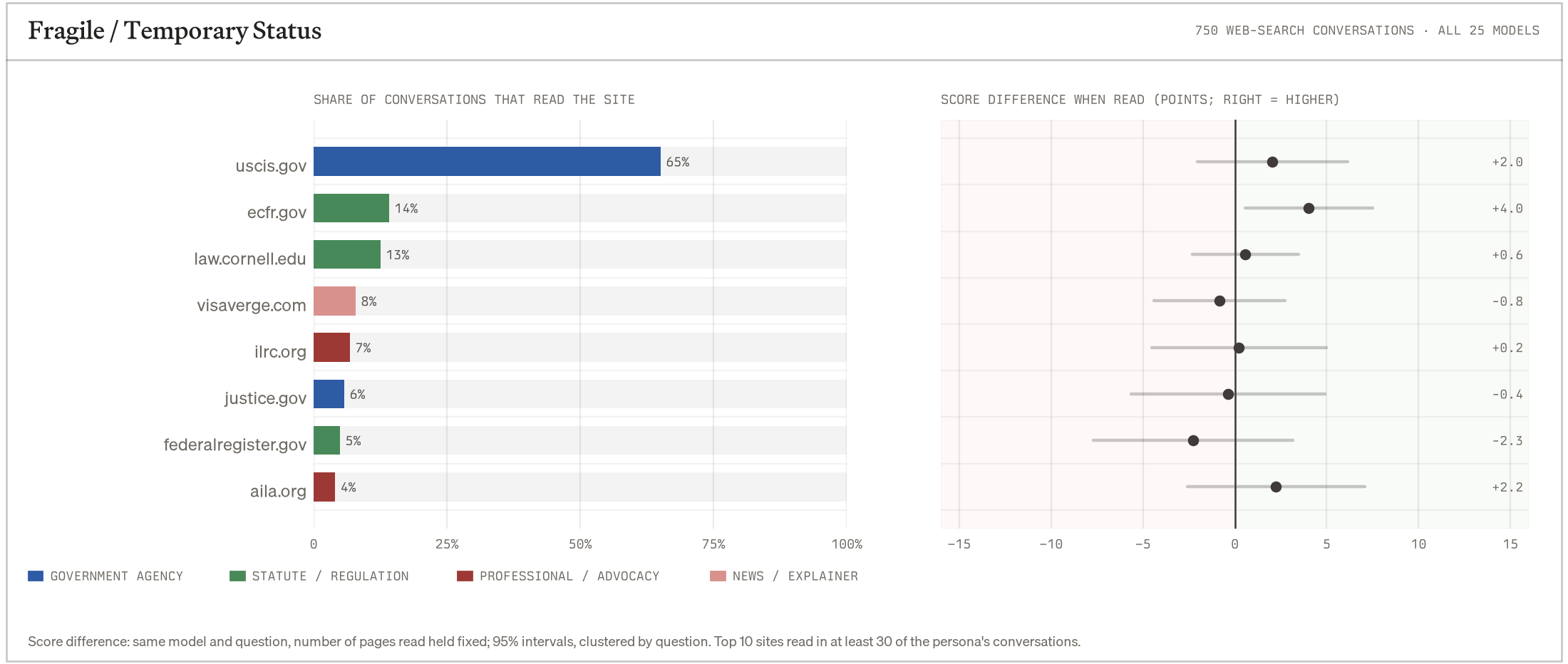
For each of the seven personas, the charts below show the websites models read most frequently during web search conversations and the score impact associated with each site.
Chart 1: Employer — Sites Read and Score Impact
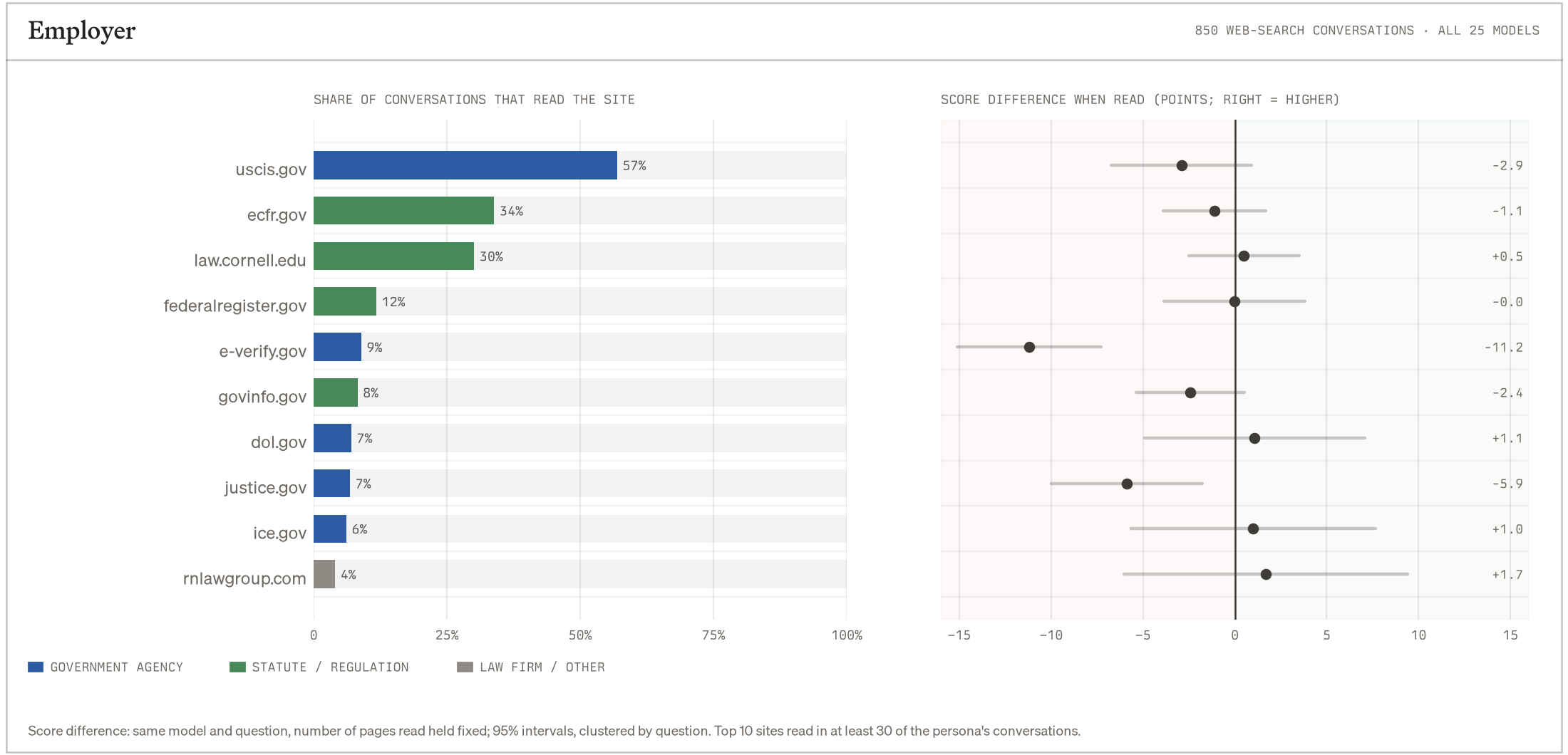
Chart 2: Entrepreneur — Sites Read and Score Impact
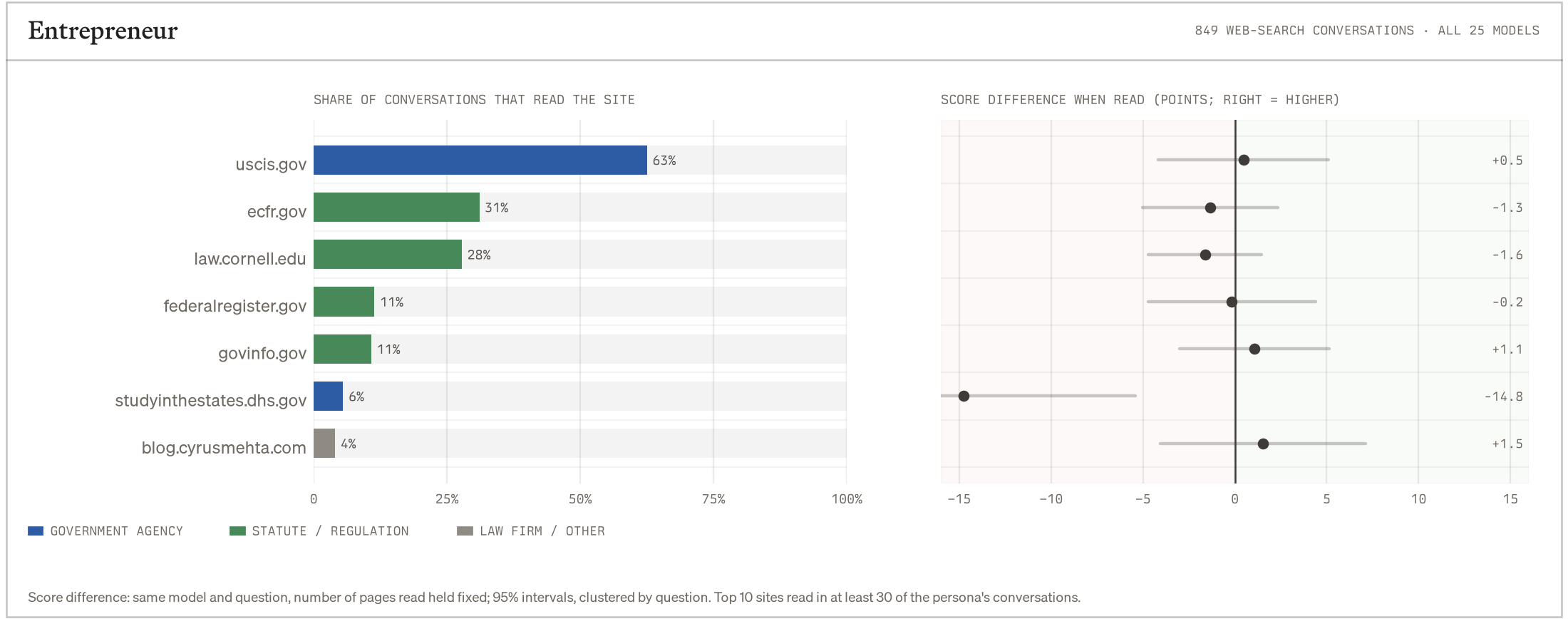
Chart 3: Self-Petitioner — Sites Read and Score Impact
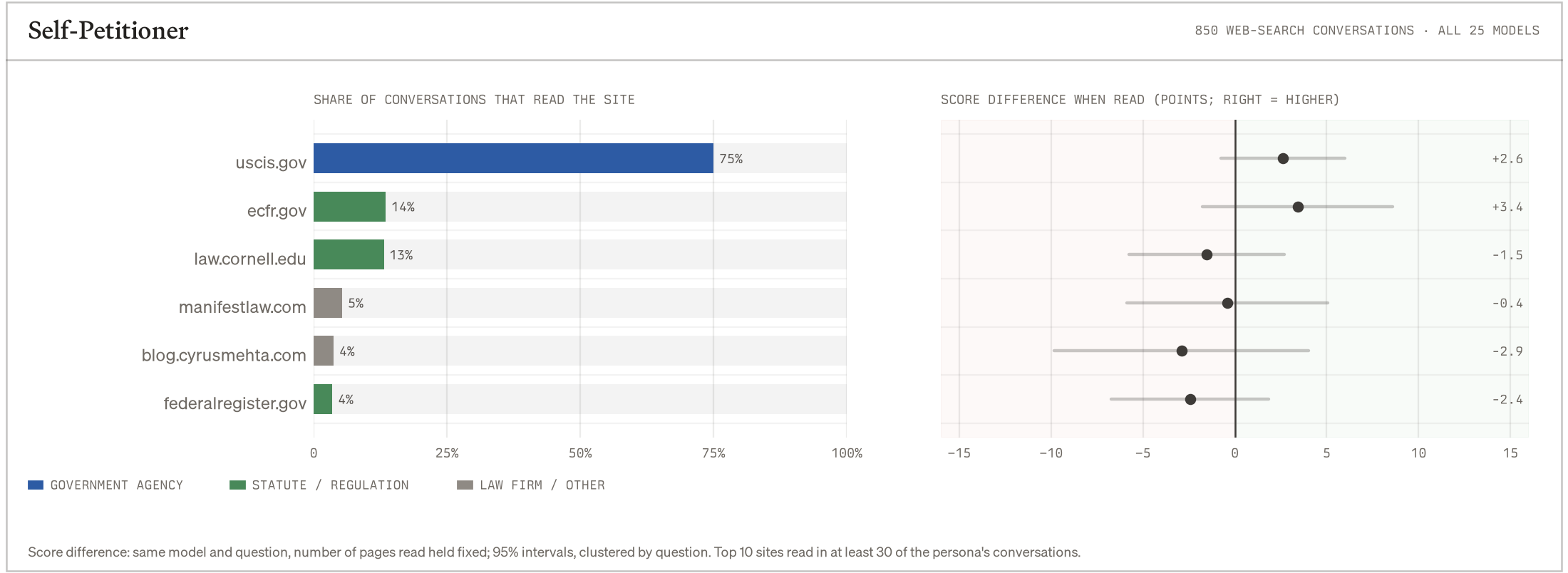
Chart 4: University Advisor — Sites Read and Score Impact
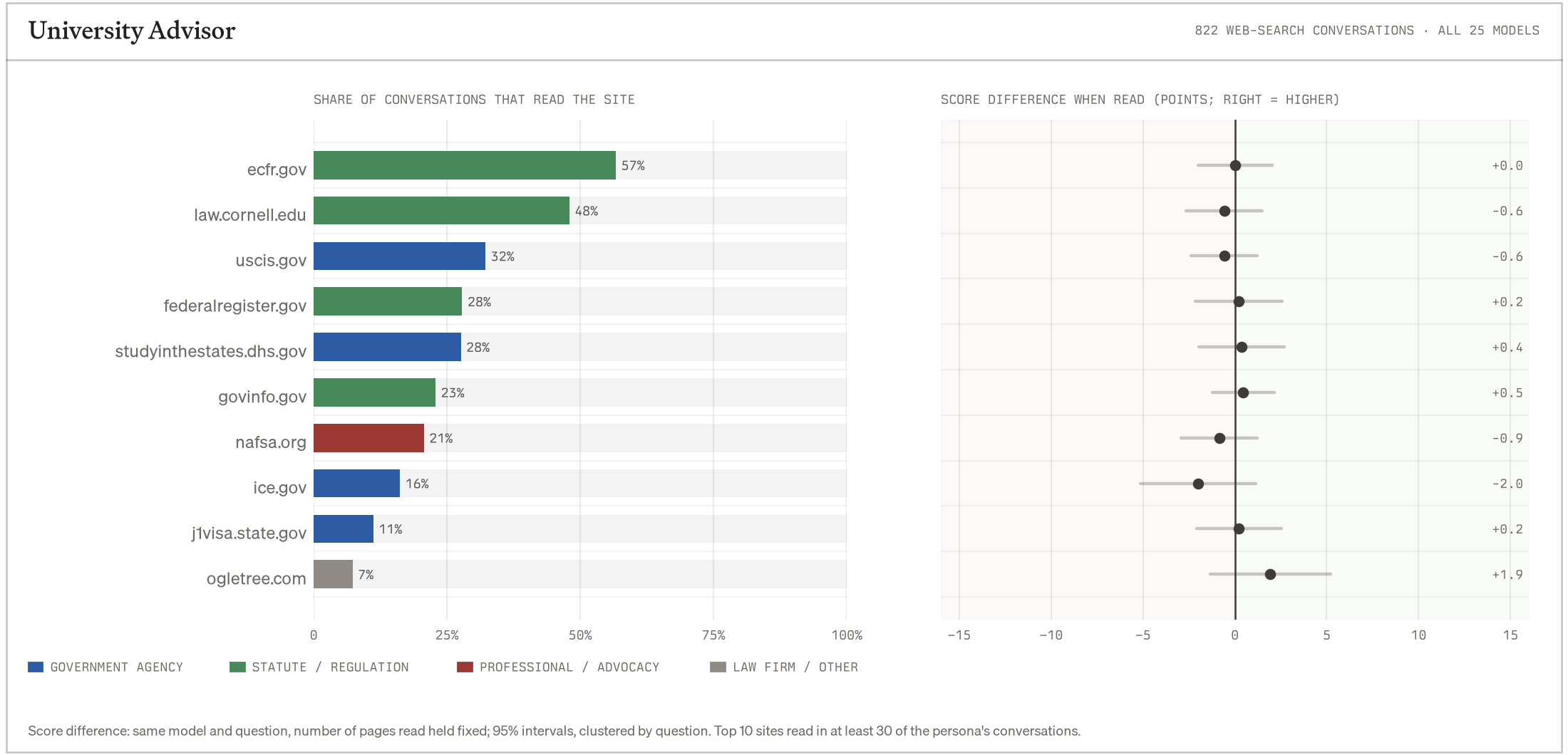
Chart 5: International Student — Sites Read and Score Impact
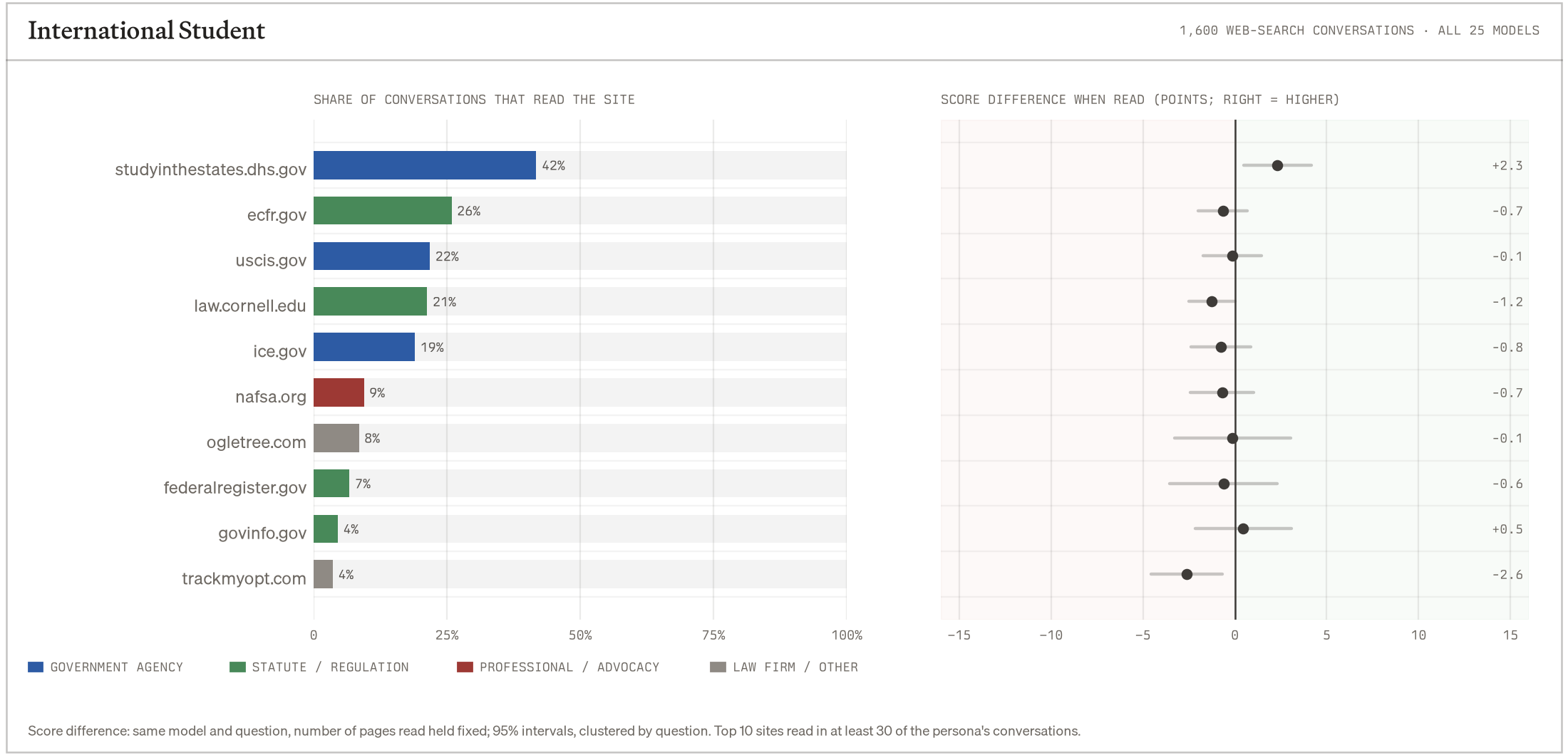
Chart 6: International Scholar/Faculty — Sites Read and Score Impact
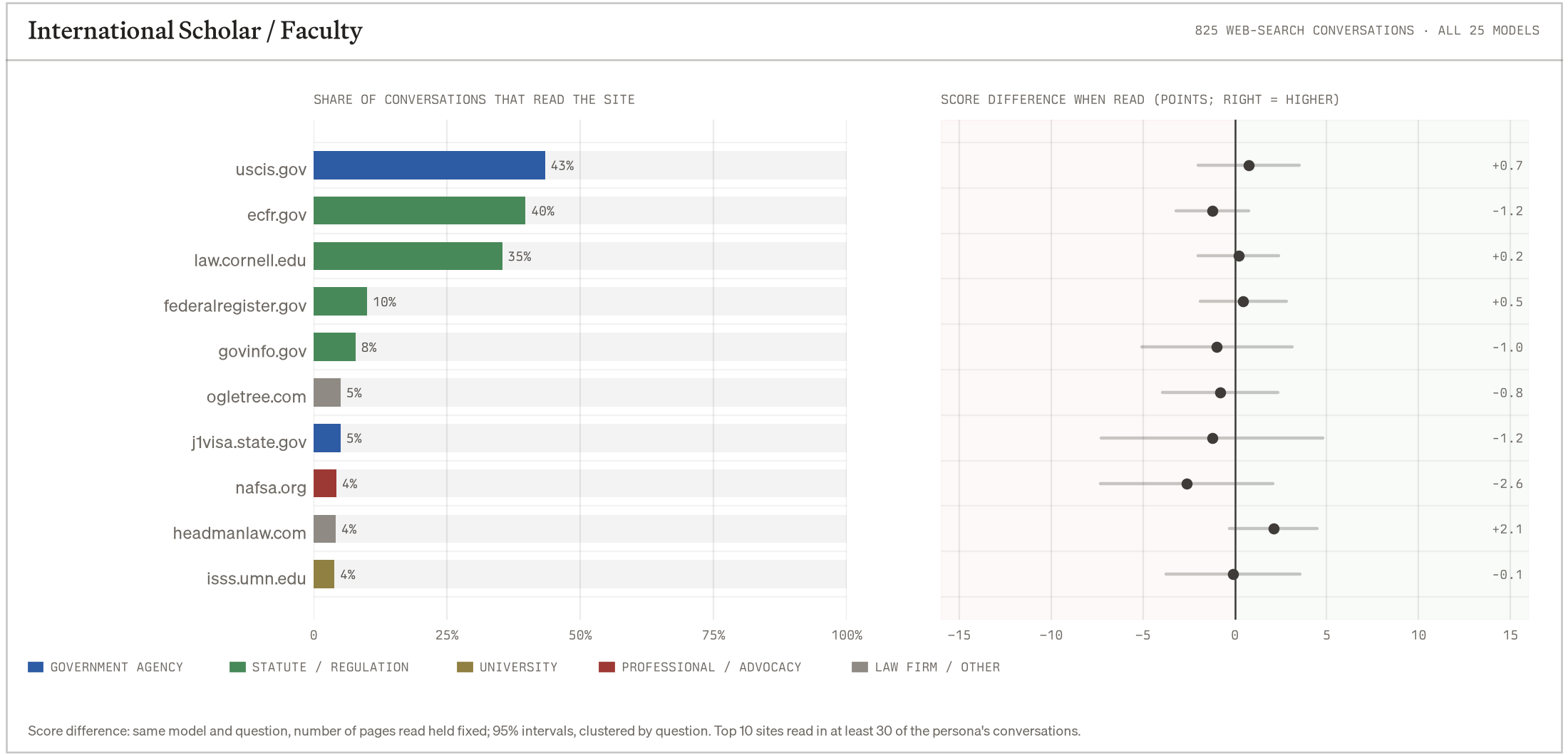
Chart 7: Fragile/Temporary Status — Sites Read and Score Impact