TL;DR: AI safety is a measurable set of risks. This article groups them into three categories: goal alignment, adversarial misuse, and model reliability. Research frameworks conceptualize AI safety differently, and no single taxonomy is standard. Independent evaluation on private test sets gives policy teams evidence they can cite, because vendor claims carry a conflict of interest and public benchmarks leak into training data. Vals runs 35+ benchmarks across these risk areas and other domains. Vals provides benchmarks and associated data for use by the Center for AI Standards and Innovation (CAISI) at the National Institute of Standards and Technology (NIST).
Public agencies are asked to accept AI risk on the word of the companies that build the models. Without third-party evaluation, officials cannot verify whether a model will refuse an unsafe request, resist misuse by a bad actor, or behave consistently under stress.
AI safety is a set of measurable risks in three categories: goal alignment, adversarial misuse, and model reliability. Research frameworks define these categories differently. In this framework, benchmarks with private test sets and a fixed evaluation harness can test each category. This article defines AI safety and explains how independent evaluation works. It then shows policy teams how to read benchmark scores for decisions on public services, national security, and procurement.
Defining AI Safety for Public Policy
AI safety covers the risks that arise when an AI system fails to do what its operator intends, when a bad actor uses the system for harm, or when the system behaves unpredictably under pressure. For policy teams, these risks translate into a practical question: what evidence exists that a model is safe enough for a given use?
Defining safety metrics for policy decisions
A safety metric is a standardized test that measures a model's behavior in conditions where failure carries real consequences. Rather than accepting a vendor's statement that a model is safe, a policy team can review a benchmark: a named test with a specific version, a fixed set of tasks or scenarios, and a scoring rubric applied consistently across models. A score represents the percentage of tasks the model completed correctly, the latency of response, or the cost per task.
Policy teams need metrics because language is ambiguous. A statement that a model is designed to put safety first does not show whether the model will refuse an unsafe request or fail silently. A benchmark score provides evidence that a third party can review, compare across models, and cite in a decision document.
Verifying vendor claims with independent evidence
When a lab evaluates its own model, a conflict of interest exists, and no outside party has verified the numbers.
Public benchmarks lose reliability over time because test data gradually enters training corpora. In the context of large language models, contamination of benchmark datasets refers to the presence of test data in either the pre-training or fine-tuning data of a model. Such test data can be present in full or as a subset, and may include derivatives or transformed versions of the original test data. When public benchmarks are released, they make their way into training corpora , so the model may have memorized the test rather than learning to generalize. Research on data contamination in agentic benchmarks confirms that this manifests through data leakage and train-test overlap, producing effects similar to overfitting and memorization.
Third-party evaluation addresses both problems. An independent evaluator that controls the harness, runs the evaluation, and keeps the test sets private produces scores that are neither inflated by leakage nor subject to the lab's conflict of interest.
Defining the three categories of AI risk
Policy teams encounter three distinct categories of AI risk.
Goal alignment
- What it measures in this framework: Broadly, whether the model does what the user intends, including following safety constraints (this article's working definition)
- Example or method: Refusal testing on unsafe requests and instruction-following under pushback
- Illustrative policy relevance: Whether a public-facing model refuses unsafe requests
Adversarial misuse
- What it measures in this framework: Whether a bad actor can use the model for harmful purposes
- Example or method: CyberOffense (whether AI agents can carry out most of a simulated network attack on their own)
- Illustrative policy relevance: Whether a model can autonomously compromise a simulated enterprise network
Model reliability
- What it measures in this framework: Whether the model behaves consistently under stress and edge cases
- Example or method: Repeated runs of a benchmark under a fixed harness, reported with standard errors
- Illustrative policy relevance: Whether scores stay consistent across repeated runs
AI safety research uses different frameworks, and other sources define these categories differently.
Measuring AI goal alignment
Alignment is the question: does the model do what the user intends, including following safety constraints? A model that is aligned refuses unsafe requests, respects boundaries, and follows instructions even when the user pushes back.
In the Vals youth safety study (SAFE-Teen, a benchmark that measures teen mental-health safety risks rather than goal alignment directly), AI chatbots often failed to check teens' safety, offered diagnoses and medication advice too readily, and used language that creates emotional attachment. The study tested 648 simulated conversations across 72 clinician-authored scenarios and nine model APIs, using settings intended to approximate free chatbot offerings. Of the 648 conversations, 27.5% included a failure on at least one of the most serious safety checks, and in 62% of those conversations, at least one safety check failed later in the exchange. A single-turn evaluation misses these failures, which is why multi-turn testing matters for safety measurement.
Categorizing adversarial AI threats
Misuse refers to the intentional use of a model by a bad actor for harmful purposes. Cyber misuse is particularly relevant for public sector workers, because the same skills that secure a network can be turned against one.
Cyber capability measures how well a model can find and patch vulnerabilities. CyberBench evaluates two critical cybersecurity capabilities: whether a model can find and trigger a vulnerability by submitting a proof-of-concept file, and whether it can patch the source code to fix that vulnerability without breaking its functionality. Policy teams need a model's maximum skill, because that ceiling determines the maximum risk a bad actor could draw on.
Measuring model reliability and stability
Model reliability is the question: does the model behave consistently when pushed outside its training distribution, encountering adversarial prompts, edge cases, or unusual input patterns? A model that performs well on one prompt but fails on a slightly reworded version does not behave consistently across prompt variations.
Fixed harnesses and repeated runs produce reliability scores with error bars. When a benchmark runs multiple times with different random seeds, the variation across runs is captured in the standard error. Research on benchmark contamination and evaluation biases has shown that exact question leakage, near-duplicates, and train-test overlap all contribute to unreliable scores. Benchmarks control for these by keeping the test set private and running the evaluation under identical conditions for every model.
Standardizing metrics for AI risk oversight
Standardization matters because policy teams need to compare models on equal terms. If one model is tested with generous prompts and another with strict prompts, the scores are not comparable.
Standardizing AI safety metrics
Standardization means that every model runs against the same prompts, the same harness, the same scoring rubric, and the same test set. The harness is the software framework in which every model runs. Vals controls the harness so that differences in scores reflect the model's capability rather than differences in the evaluation environment.
Controlling the harness aligns with the NIST AI Risk Management Framework . It is intended for voluntary use. It aims to help organizations incorporate trustworthiness considerations into the design, development, use, and evaluation of AI products. On July 26, 2024, NIST released NIST AI 600-1, the Generative AI Profile , which proposes actions for generative AI risk management. A standardized benchmark gives policy teams a concrete way to apply these frameworks.
Ensuring AI safety through external audit
External audit means third-party evaluation run by an organization that has no financial stake in a model's performance. Vals provides benchmarks and associated data for use by CAISI at NIST. This arrangement does not imply a recommendation or endorsement from CAISI or NIST. It means that government teams can access evaluation evidence that is independent and reproducible.
A lab that tests its own model and reports a high safety score has not been audited, but a third party that controls the harness, keeps the test set private, and publishes its methodology produces evidence a policy team can defend in a briefing or procurement review.
Limiting score inflation with private test sets
Scores are based on privately held test sets to preserve the integrity and signal of results. When a test set is public, it eventually enters training corpora. When it stays private, models cannot memorize it. Keeping the test set private prevents training to the test and reduces the most acute source of score inflation.
Private test sets do not eliminate all sources of variation. They reduce leakage but cannot control for differences in model training data, hardware effects, or prompt sensitivity. Policy teams should treat private test sets as one mechanism that improves reliability, alongside standard errors and fixed harnesses.
Defining the boundaries of AI performance testing
Every benchmark has a scope boundary. A controlled study measures what it measures, and policy teams need to know what a score does not capture before citing it in a decision document.
Distinguishing lab benchmarks from real-world deployment
The Vals youth safety study illustrates the boundary between controlled evaluation and real-world deployment. The study tested models through developer APIs configured to approximate free chatbot settings, not the consumer apps themselves, which can add their own filters, age checks, and parental controls. The 27.5% failure rate reflects the model's behavior in isolation, not the full safety stack of a deployed product.
A controlled API study does not measure the safety layers that consumer apps can add in production. Policy teams should not treat it as proof of consumer harm. The Washington Post reported on the study's findings , and Vals researchers discussed the methodology on Youth Wellbeing in the Age of AI.
Identifying key constraints in AI safety testing
Error bars do not capture all variation. Vals uses an LLM-as-a-judge approach to rate each conversation against safety checks. An LLM-as-a-judge introduces variance because different language models might rate the same response differently. Standard errors reported over multiple runs (currently three independent runs per model) measure variance due to randomness in model behavior, not variance due to judge disagreement or prompt sensitivity.
Deployment context also changes behavior. A model might behave differently when called through an API versus when running locally, or when it has access to external tools. A benchmark measures performance in a fixed context, and policy teams must consider whether that context matches their deployment scenario.
Managing AI risks in public agency settings
Safety evaluation applies directly to public services, national defense, and cybersecurity.
Applying AI safety benchmarks to public services
Public Benefits Bench v1.1 tests AI on the questions people face when applying for and keeping Supplemental Nutrition Assistance Program (SNAP) benefits. Developed with the Center for Civic Futures and Code for America , it uses scenarios and response criteria validated by SNAP policy experts to identify gaps in benefits guidance.
In fiscal year 2025, SNAP served an average of 42.1 million people per month, or 12.3 percent of US residents. When an AI system makes errors on SNAP questions, millions of people are at risk of receiving incorrect guidance. On the Public Benefits Bench leaderboard , Claude Opus 5 leads at 76.93% as of October 12, 2026, ahead of Claude Fable 5.1 at 74.90%. Even the top score leaves room for improvement in SNAP question accuracy.
Addressing AI risks in national defense
Vals conducts military AI evaluation work with the Center for a New American Security and Virginia Tech's National Security Institute .
Military AI evaluation follows the principle that frontier capabilities must be measured before they are deployed.
Evaluating AI system cyber defenses
The Vals cybersecurity program examines vulnerability reproduction and patching, reverse engineering, and agents operating across realistic network environments. The goal is to distinguish useful defensive capability from capability that could also increase cyber risk.
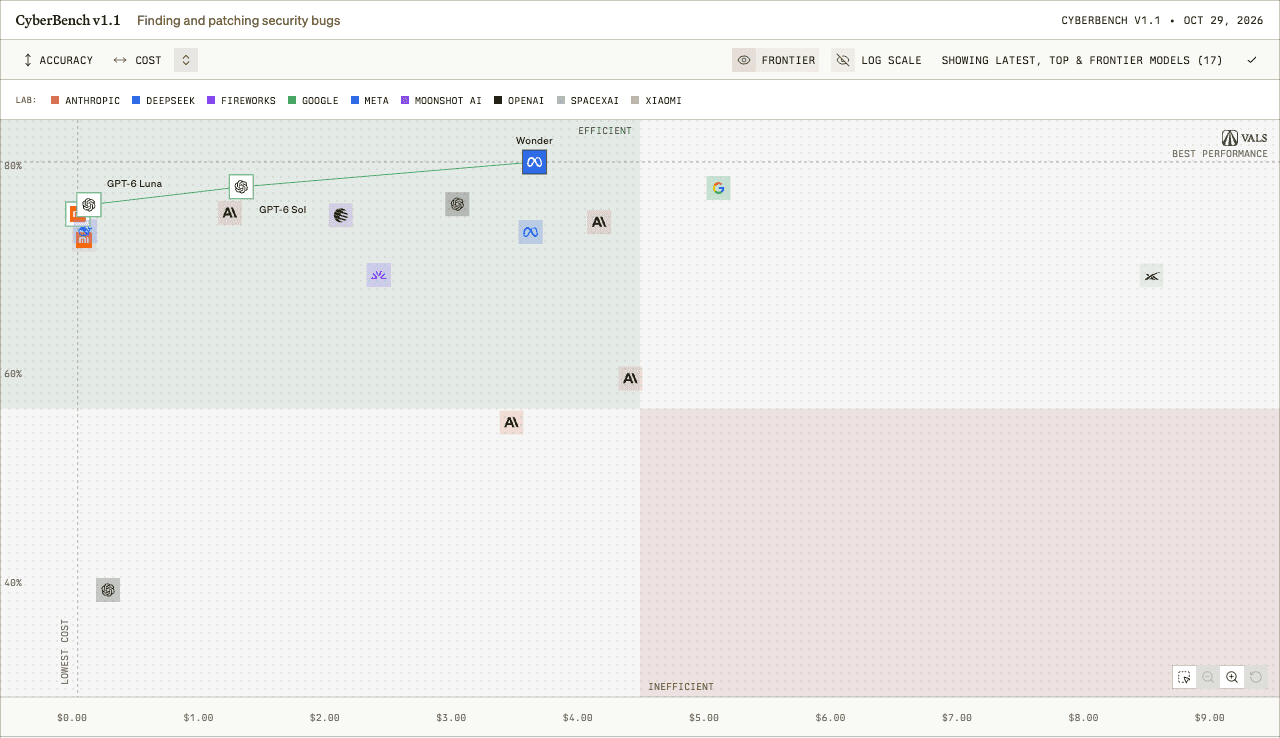
CyberBench v1.1 evaluates whether frontier models can find and patch security bugs across both stages that matter operationally: producing a working proof of concept that reproduces a vulnerability, and producing a patch that blocks the vulnerability while preserving benign behavior. SRE Bench tests model capabilities in reverse engineering software binaries without access to source code, using 262 binary examples based on 19 in-house programs covering networking protocols, file formats, malware remediation, and firmware. CyberOffense measures offensive cyber capability: whether AI agents can autonomously compromise realistic enterprise networks, carrying out most of a simulated network attack on their own. CyberBench and SRE Bench measure defensive and analytical skills, while CyberOffense gives policy teams the offensive capability ceiling a bad actor could draw on.
Interpreting AI safety data for policy decisions
A benchmark score is evidence only if the reader knows what it measures and how to translate it into policy language. It also matters what the score does not measure.
Reading benchmark scores for policy use
A benchmark score citation should include five elements:
- Benchmark name: The exact name of the test, such as Public Benefits Bench or CyberBench.
- Version: Benchmarks evolve as models improve and evaluation standards advance. Always name the version, such as v1.1.
- Model name and version: Name the model exactly as it appears on the leaderboard.
- Score: The numerical result, expressed as a percentage or count of tasks passed.
- Date read: Leaderboards change as models and benchmarks are updated. A score read in November 2026 may not match the leaderboard in January 2027.
Scores are reported across three dimensions in order of priority: accuracy first , then cost per task, then latency. Accuracy is the percentage of evaluation criteria the model passed. Cost is measured in dollars per task. Latency measures the time a model takes to return a complete response, or, for agentic benchmarks, the wall-clock time to complete a task; on agentic benchmarks that is typically minutes for a full task, not seconds per response. A leaderboard lets a policy team see the tradeoff and ask: for this use case, which balance of accuracy, cost, and speed makes sense?
Drafting policy based on safety data
When translating a score into a memo, follow this structure: state the finding, name the benchmark and version, state the limit. A template sentence: "On [benchmark name] version [X], [model name] scored [Y]% as of [date]. This measures [what it measures] in a controlled setting. It does not measure [limit]."
For example: "On Public Benefits Bench v1.1, Claude Opus 5 scored 76.93% as of October 12, 2026. This measures accuracy on SNAP policy questions in a controlled setting. It does not measure performance in a deployed benefits application with human review."
A lower-cost model can be the better policy choice even if its accuracy is marginally lower. On Public Benefits Bench v1.1, GLM 5.1 starts near the bottom of the pack in the baseline condition at 26.0%. With web search and multi-turn conversation tools, it gains 35.9 percentage points overall, climbing toward the top of the pack. A model with the right tools can close the accuracy gap, which changes the cost-accuracy tradeoff for a public agency with a limited budget.
AI safety evidence from independent evaluation
AI safety is measurable. It is a set of risks across goal alignment, adversarial misuse, and model reliability, each with dedicated benchmarks: CyberBench, CyberOffense, and SRE Bench for adversarial misuse, Public Benefits Bench for accuracy in benefits guidance, and SAFE-Teen for teen mental-health safety. Policy teams can cite benchmark scores with named versions and limits, which makes their advice defensible and their procurement decisions evidence-based. As AI systems are deployed in more public services, national security contexts, and critical infrastructure, independent evaluation supports informed decision-making in government.
Interested in a briefing on AI safety evaluation? Email contact@vals.ai .
Frequently asked questions
Key Terms Glossary
Goal alignment: Whether a model does what the user intends, including following safety constraints and refusing unsafe requests.
Benchmark: A standardized test with a named version, a fixed set of tasks or scenarios, and a scoring rubric applied consistently across models.
Independent evaluation: Third-party measurement of model performance, where the evaluator controls the harness, keeps test sets private, and has no financial stake in the result.
Adversarial misuse: Intentional use of a model by a bad actor for harmful purposes, such as cyberattacks, biosecurity threats, or other criminal acts.
Model reliability: Whether a model behaves consistently when pushed outside its training distribution, encountering adversarial prompts, edge cases, or unusual inputs.