TL;DR: AI security covers the ways AI agents can be attacked that traditional software cannot. The main attacks are prompt injection, jailbreaks, data poisoning, and tool misuse. Model weights raise a separate problem, because attackers try to steal them. A related question is cyber capability, which is how well a model can hack. Cyber capability sets the stakes for cyber alignment, which is how likely a model is to hack on behalf of a bad actor. Vals measures cyber capability with CyberBench v1.1, SRE Bench, and CyberOffense.
AI agents read outside content, call tools, and act on their own. Those abilities give attackers ways in that traditional software does not have. Hidden instructions in a web page can redirect an agent. A poisoned document can change what an agent retrieves, and an over-permissioned tool can turn a bad output into a damaging action. This article explains the four main ways AI agents get attacked and why model weights need separate protection. It also covers how cyber capability is measured and why it matters for cyber alignment.
What makes AI security different
AI security differs from traditional cybersecurity because an AI model follows instructions written in plain language. Traditional software runs fixed code, so a patch can close a known flaw. An AI model can refuse a harmful request in one context and comply in another. Its output depends on the prompt, the context, and the data it reads. NIST describes attacks specific to machine learning, such as data poisoning and evasion , that have no direct equivalent in traditional software.
Two public references catalog these attacks. The OWASP Top 10 for LLM Applications ranks the main risks for applications built on large language models, with prompt injection first. MITRE ATLAS maps adversarial techniques against AI systems, much as MITRE ATT&CK does for traditional IT systems. Both give security teams a shared vocabulary for attacks on AI systems.
How AI agents get attacked
AI agents face four main attacks: prompt injection, jailbreaks, data poisoning, and tool misuse. Each one targets a different part of how an agent works.
Hiding instructions with prompt injection
Prompt injection is an attack that hides instructions in content a model reads, so the model follows the attacker instead of its original task. OWASP ranks prompt injection as the top risk for LLM applications (LLM01). Direct prompt injection occurs when a user's prompt directly alters the model's behavior. Indirect prompt injection occurs when a model accepts input from external sources, such as websites or files, that carry hidden instructions.
Indirect prompt injection matters most for agents, because an agent reads outside content as part of its work. An agent that processes email or web pages can pick up instructions hidden in that content. OWASP recommends regular penetration testing that treats the model as an untrusted user, so a team can check its trust boundaries and access controls.
Bypassing safety rules with jailbreaks
A jailbreak is a prompt designed to make a model ignore its safety rules. OWASP treats jailbreaking as a form of prompt injection. Attackers often use roleplay or hypothetical framing to coax a model past its policy.
Jailbreaks connect AI security to cyber alignment. A model that refuses to write attack code under normal use may write it once a jailbreak succeeds. OWASP notes that preventing jailbreaks requires ongoing updates to a model's training and safety mechanisms. A defense that works against today's techniques can fail against a new one.
Poisoning training and retrieval data
Data poisoning is the manipulation of data a model learns from or retrieves, so that the model behaves the way an attacker wants. OWASP lists data and model poisoning as LLM04. Poisoned training or fine-tuning data can plant backdoors that activate only under specific conditions.
Agents add a second target: the documents and memory they read at run time. Published attacks such as PoisonedRAG , AgentPoison , and MemoryGraft poison retrieval-augmented generation (RAG) databases or an agent's long-term memory to bias its future actions. OWASP recommends data version control to track changes to datasets. It also recommends anomaly detection to filter out adversarial data.
Misusing agent tools through excessive agency
Tool misuse happens when an agent takes damaging actions through its tools in response to unexpected, ambiguous, or manipulated model outputs. OWASP calls this risk excessive agency and lists it as LLM06. The risk grows when tools run with more permissions than the task needs, because a single bad output can then run code or change a database.
Tool misuse is often where the other attacks end. A prompt injection or a poisoned document causes harm once the agent acts on it. OWASP recommends limiting the tools an agent can call to the minimum necessary, with the minimum permissions. It also recommends requiring user approval before high-impact actions.
Protecting model weights from theft
Model weights are the learned parameters of a neural network. Weights need different protection from attacks on AI agents, because attackers want to steal them. The 2023 OWASP Top 10 for LLMs listed model theft as LLM10 . The 2025 version folds model theft into Unbounded Consumption , a wider category that also covers denial of service.
Weight protection relies on standard security controls. OWASP lists access controls, encryption, and continuous monitoring . RAND recommends keeping all copies of the weights on a limited number of access-controlled, monitored systems . A stolen copy of the weights can be run outside the owner's safeguards, which links weight protection to cyber alignment.
Measuring AI cyber capability and its link to cyber alignment
Prompt injection, jailbreaks, data poisoning, and tool misuse are attacks on an AI system. A separate question is what a model could do as an attacker itself. Cyber capability is how well a model can hack. Cyber alignment is how likely the model is to hack on behalf of a bad actor.
Measuring how well models can hack
Vals measures cyber capability with three proprietary benchmarks. Each benchmark tests a different hacking skill, so each score describes only that skill.
- CyberBench v1.1 tests whether AI agents can find security bugs and patch them.
- SRE Bench tests whether AI agents can work out what a real-world binary does without its source code.
- CyberOffense tests whether AI agents can compromise simulated enterprise networks on their own.
The leaderboards show how far current models get on each skill. As of October 29, 2026, Wonder ranks first on CyberBench v1.1 with 80.36%, followed by GPT-6 Sol at 77.98%. As of November 2, 2026, GPT-6 Astra ranks first on SRE Bench with 56.87%. On the CyberOffense leaderboard updated October 23, 2026, GPT-6 Sol Daybreak completed 27 of 31 attack objectives on Lighthouse, the harder of its two simulated networks.
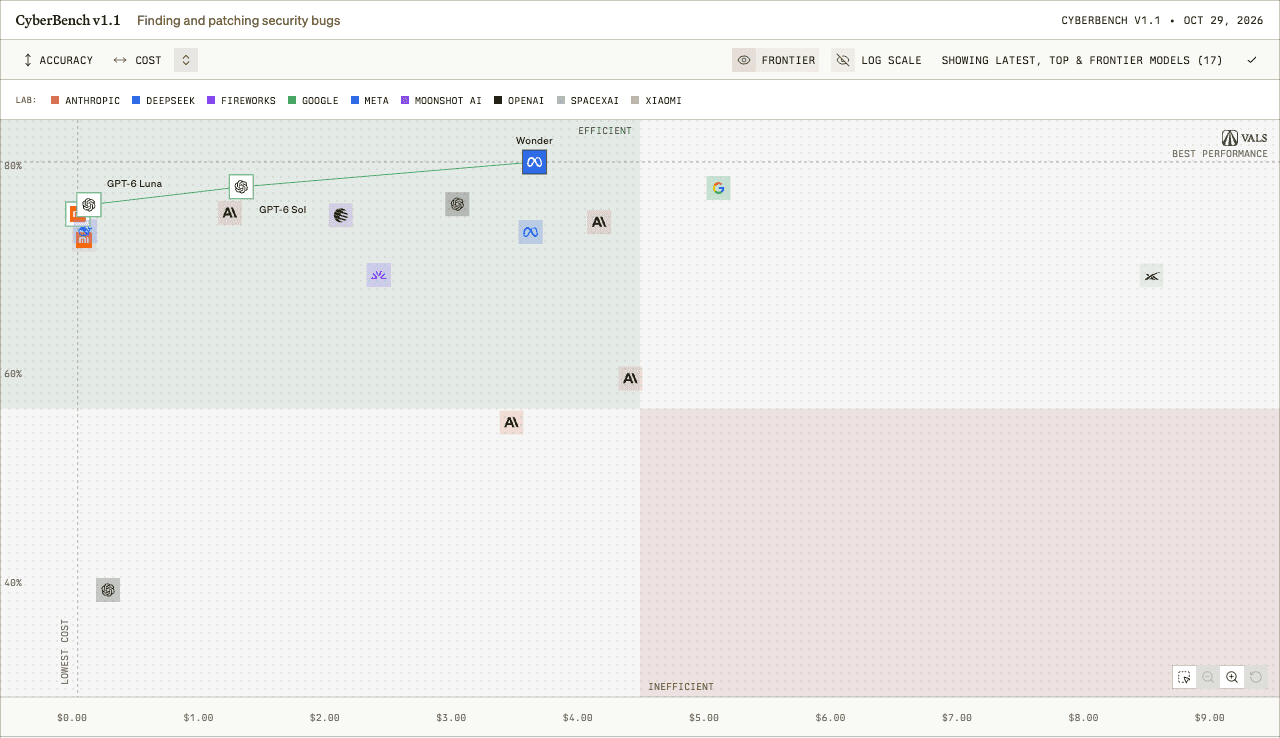
These scores come from controlled runs on benchmark tasks, so they describe capability on those tasks. Behavior in a real deployment also depends on access controls, monitoring, and the model's alignment.
Connecting cyber capability to cyber alignment
Cyber capability sets the stakes for cyber alignment. A model with low cyber capability can do little harm even if a bad actor convinces it to help. A model with high cyber capability needs strong alignment, because a successful jailbreak would put that capability in an attacker's hands.
Open-weight models raise the stakes further. The CyberOffense findings show that cyber capability once limited to trusted-access AI is now available to anyone. On Nova, the open-weight DeepSeek V4.1 Flash 1017 averaged 16.3 of 21 objectives. GPT-6 Sol Daybreak, which OpenAI offers only through its restricted Daybreak cyber program, averaged 15.7. Once a model's weights are public, no provider can monitor or stop how it is used.
Conclusion
AI agents can be attacked through the inputs they read, the safety rules they follow, the data they rely on, and the tools they call. Each attack needs its own defense, from penetration testing for prompt injection to user approval for high-impact tool calls. Model weights need separate protection, because a stolen copy runs outside its owner's safeguards. Measuring cyber capability shows how much harm a model could do if those defenses or its alignment fail.
Interested in a briefing on AI cyber risk? Use the Request a briefing form or email contact@vals.ai .
Frequently asked questions
Key terms glossary
AI security: The practice of protecting AI agents from attacks that exploit how models read inputs, use data, and call tools.
AI agent: An AI system that takes actions through tools, such as running code or querying a database.
Prompt injection: An attack that hides instructions in content a model reads, so the model follows the attacker instead of its original task.
Jailbreak: A prompt designed to make a model ignore its safety rules. OWASP treats jailbreaking as a form of prompt injection.
Data poisoning: Manipulation of the data a model learns from or retrieves, so the model behaves the way an attacker wants.
Tool misuse: An agent taking damaging actions through its tools. OWASP calls the underlying risk excessive agency.
Model weights: The learned parameters of a neural network. Attackers target them for theft.
Cyber capability: How well a model can carry out hacking tasks, such as finding security bugs or compromising a network.
Cyber alignment: How likely a model is to hack on behalf of a bad actor.