
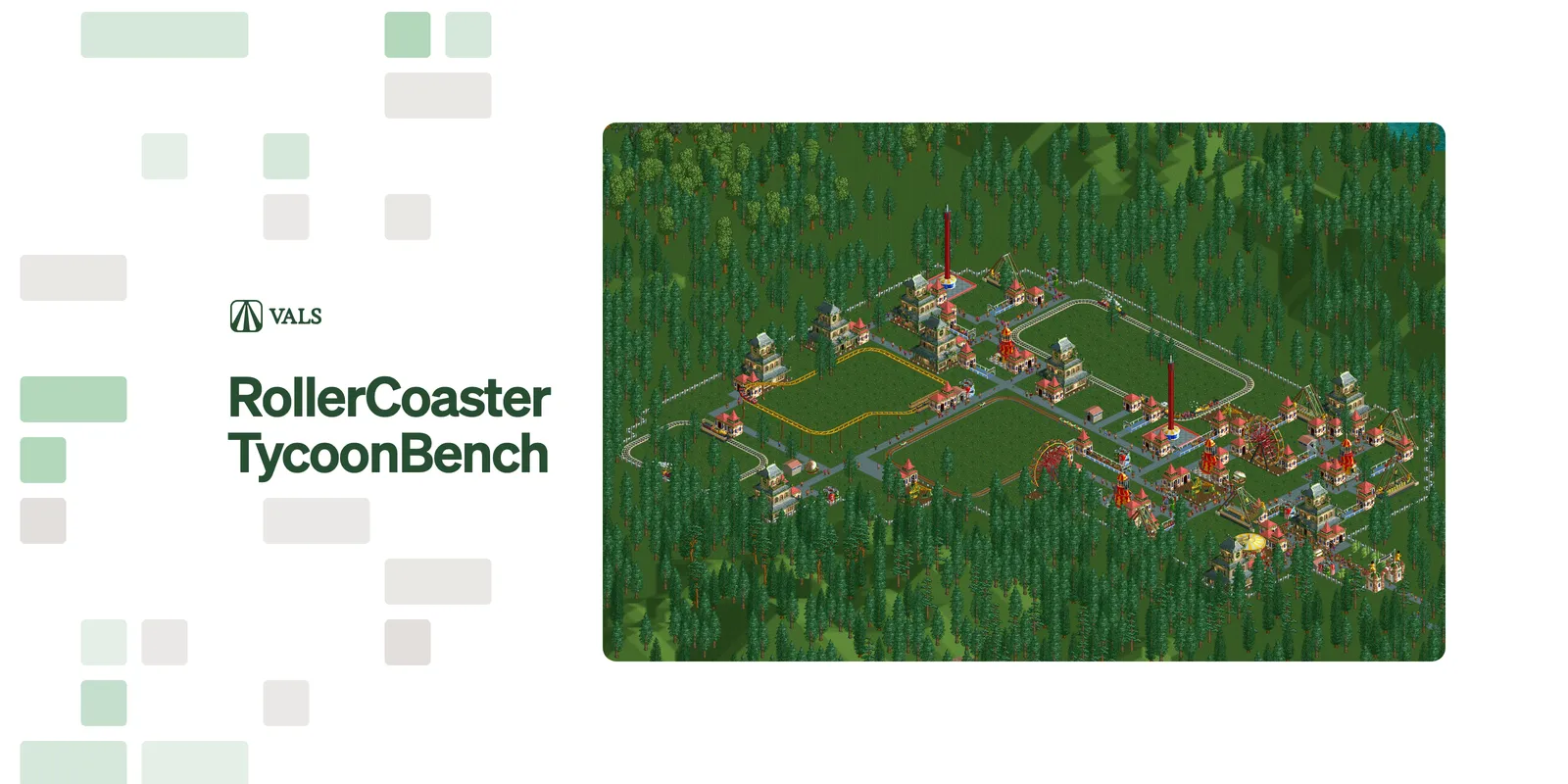
A decision model takes a situation and a list of options and returns a probability for each. Most benchmarks for these models ask independent questions. In RollerCoasterTycoonBench every answer changes the next question: the model runs a RollerCoaster Tycoon 2 park for three in-game years, one week at a time, with a goal of 1,000 guests.
Nine models played three runs apiece, and three reached the goal in one run each: Decider V1.2, Decider V1.3, and GPT-6 Luna Decisions. We score each run half on the goal and half on the park’s company value, the figure the game uses to rank finished parks. Decider V1.3 scored highest, 71 out of 100 on average. The RollerCoasterTycoonBench benchmark page shows every decision of every run.
Key takeaways
- Decider V1.3, the highest scorer, borrowed early in every run and spent the money at once. Its three runs ended with 965 to 1,042 guests.
- Models often let weeks pass with money to spend. Drex Max ended 43 to 49 of its 96 weekly turns without acting, and in 28 to 35 of those weeks it could afford to build.
- A model’s confidence said little about how well it played. Models gave their chosen option 37 to 48 percent probability on average, whether they scored high or low.
- Seven of the nine models averaged more guests when the state listed construction prices, as RollerCoasterTycoonBench does by default. Drex Max averaged 836 guests with prices listed and 409 without.
The benchmark
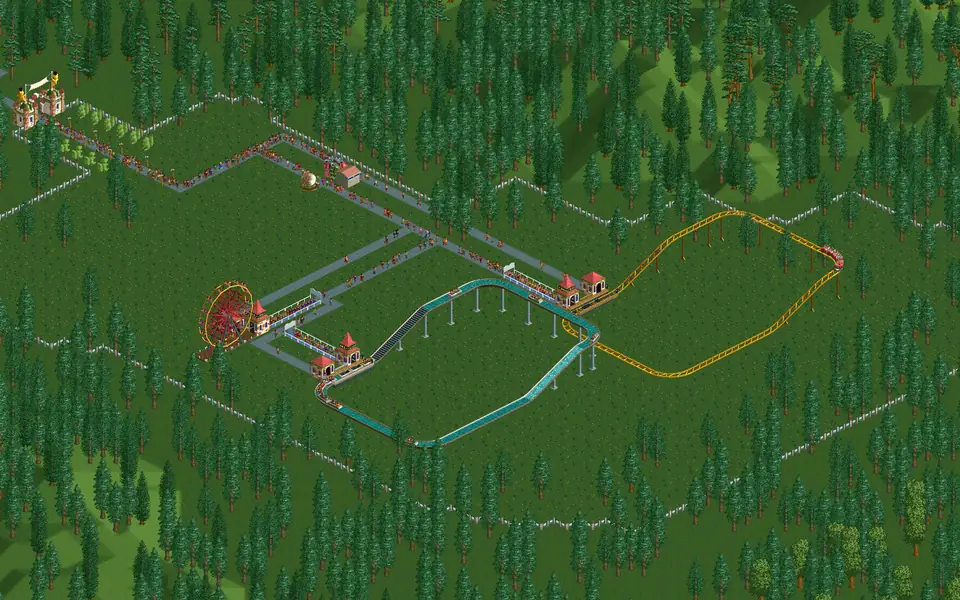
RollerCoasterTycoonBench runs OpenRCT2, the open-source version of RollerCoaster Tycoon 2, on the original game data with no screen. Every run starts in Forest Frontiers, an empty clearing with $10,000 in cash and a $10,000 loan that the bank will raise to $30,000. The goal is 1,000 guests and a park rating of 600, on the game’s 0 to 999 scale, at the end of October in year 3. The game’s year runs from March to October, so a run lasts 96 weekly turns.
Each week the model can open up to six of the game’s windows, such as construction, staff, or finances, and make one change in each: build a ride or a stall (a food stand, shop, or restroom), hire a mechanic, change a price, or take out a loan. Rides and stalls together make up a park’s attractions. Each question lists only the options that are legal and affordable at that moment, shuffled on every call, and the harness carries out the one the model gives the highest probability. With each question the model receives the state: everything a player could see on screen, written as text, including every construction item and its price.
Half of a run’s score is the share of the goal it met (the lower of guests ÷ 1,000 and rating ÷ 600, capped at 1), and half is company value ÷ $100,000. Company value is park value plus cash, minus the loan. Park value rises with each ride’s ratings and riders, so a ride nobody rides adds little. A park that ends in debt loses points. A model’s score is the mean over its three runs.
Model behavior
Decider V1.3 borrowed $5,000 three times in the first 19 weeks of every run, each time with less than $1,600 in cash, and spent it at once. GPT-6 Luna Decisions set prices from what guests said, raising a ride’s price ten cents at a time while guests still called it good value.
Several models let weeks pass with money to spend. Drex Max let 43 to 49 of the 96 weeks pass without opening a window, and in 28 to 35 of those weeks it could afford to build. In its first run Decider V1.2 passed 1,000 guests in week 34, then let 38 of its last 48 weeks pass while its cash grew to $15,826.
Others stayed busy without making progress. Decider Flash V1.2 changed how often mechanics inspect a ride 439 to 469 times per run, but never hired a mechanic. In week 71 of its second and third runs, 14 of 18 and 16 of 19 attractions were broken down, and its parks finished with 79 to 118 guests.
Two models spent past their means. In its first run Decider Flash V1.3 built 17 rides and stalls in four weeks and never built again. It hired 99 staff, 65 of them entertainers, and finished $75,967 overdrawn. Jev 1.13.0 finished two of its three runs more than $10,000 overdrawn, though those parks still had 863 and 940 guests. Across all 27 runs, 20 borrowed and none repaid any of it.
Harness design choices
A model can pick only from the options the harness gives it, so the harness affects the score. To test option order, the stated objective, and the rule that opening a window commits the model to one change, we replayed 100 recorded decisions from each of six models with one thing changed. Resending the identical request changed 0 to 9 percent of picks, and reshuffling the options changed 0 to 34 percent, so we count a design choice as mattering only if it moves more picks than that.
GPT-6 Luna Decisions picked the first-listed window and ride more often than chance, but because RollerCoasterTycoonBench shuffles the options on every call, that preference adds noise to a run without steering it. Removing the stated role and objective changed 19 to 35 percent of picks for four of the six models, more than reshuffling did. Removing the rule moved only Gemini Decision 1.
We also ran each model three more times with no construction prices in the state and the build window offered only when something was affordable, so a model couldn’t tell that a loan would buy a ride. Seven of the nine models averaged more guests with prices listed. Drex Max averaged 836 guests with prices and 409 without. With three runs in each variant, no single model’s difference is statistically significant.
- Guests
- 418
- Rating
- 607
- Cash
- $169
- Loan
- $10,000 / $30,000
- Attractions
- 6
- Staff
- 10
Drex Max has $169 in cash and $20,000 it could borrow. No build window is offered, the state lists no prices, and it lets the week pass (39%).
State
{
 "park": {
  "name": "Forest Frontiers",
  "open": true,
  "rating": 607,
  "guests_in_park": 418,
  "park_value": 32191,
  "company_value": 22611.9,
  "cash": 168.8,
  "bank_loan": 10000,
  "max_bank_loan": 30000,
  "loan_interest_rate_percent": 10,
  "entrance_fee": 0,
  "total_admissions": 1114,
  "income_from_admissions": 0,
  "park_size_tiles": 1610,
  "land_price": 30,
  "construction_rights_price": 20,
  "flags": {
   "open": true,
   "scenarioCompleteNameInput": false,
   "forbidLandscapeChanges": false,
   "forbidTreeRemoval": false,
   "forbidHighConstruction": false,
   "preferLessIntenseRides": false,
   "forbidMarketingCampaigns": false,
   "preferMoreIntenseRides": false,
   "noMoney": false,
   "difficultGuestGeneration": false,
   "freeParkEntry": true,
   "difficultParkRating": false,
   "unlockAllPrices": false
  }
 },
 "this_week": []
}which window to open
- Land: buy land or clear trees and scenery.6.5%
- Finances: bank loan.26%
- Done for this week: let time pass.39%
- Footpaths, footpath items and scenery.4.5%
- An attraction's window: price, operating, departure, maintenance and music tabs; close, reopen or demolish (6 attractions).1.5%
- Research: funding level and categories.5.4%
- Marketing campaigns.6.5%
- Staff: hire, fire, or manage someone (10 staff now).11%
Methodology
We tested all models through their providers’ APIs, three runs per model. All results use the harness described here, except the variants under Harness design choices.
After every run we check that each pick was a listed option and that each purchase and action matched the game’s own records. The only exceptions were in GPT-6 Luna Decisions’ runs. Its provider refused 16 of its 4,909 calls, and 42 of 4,572 in the prices-hidden variant. The harness took no action on those calls. In one run a ride’s window misreported its profit for a week, and a restroom cost $10 more than stated.
A state can run to about 44,000 tokens. To check that models read all of it, we placed a one-line instruction at different points in a 140,000-character state, and each of the five models we checked followed it wherever it appeared. Version 1 leaves out free-form path drawing, the chairlift, custom coaster track, large scenery, water, cosmetic changes, and the game’s other scenarios.
Citation
Please cite this work as:
Citation (BibTeX)
@article{valsai2026rctbench,
title        = {Building RollerCoasterTycoonBench: Can Decision Models Manage a Theme Park?},
author       = {Connor Frank},
year         = {2026},
month        = nov,
howpublished = {Vals AI},
url          = {https://vals.ai/blogs/building-rctbench},
}